Vietcraft.art
Vietnamese Dan Bau – The Story, Craft, Sound, and Cultural Heritage of Vietnam’s One-String Instrument
Vietnamese Dan Bau – The Story, Craft, Sound, and Cultural Heritage of Vietnam’s One-String Instrument
Couldn't load pickup availability
VIETNAMESE DAN BAU – THE ONE STRING THAT CAN SPEAK
The Story of Vietnam’s One-String Monochord, Its Sound, Craftsmanship, Playing Techniques, and Cultural Journey.
There are musical instruments that need dozens of strings to create a world of sound.
There are instruments with keyboards, frets, pedals, bows, valves, and complicated mechanical systems.
And then there is the Dan Bau.
One string.
One resonating body.
One curved rod.
One small plectrum.
And yet, from that single string, Vietnamese musicians can create sounds that seem to bend, cry, whisper, sing, tremble, laugh, and almost speak.
This is one of the great mysteries of the Dan Bau, the traditional Vietnamese monochord.
To a Western listener seeing the instrument for the first time, the question may be immediate:
How can one string possibly produce so many different musical colors?
The answer is not simply hidden in the string.
It is hidden in the relationship between the string, the resonating body, the harmonic nodes, the flexible voi dan or playing rod, the player's two hands, and a highly developed Vietnamese tradition of musical expression.
The Dan Bau is therefore much more than a one-string instrument.
It is an instrument built around the art of transforming a single vibration into an enormous range of emotional expression.
And when the instrument is made with a carefully selected go huong body, a lightweight go ngo dong soundboard, a buffalo-horn voi dan, and traditional kham trai mother-of-pearl decoration, it becomes something more than a musical object.
It becomes a meeting point between Vietnamese acoustics, traditional craftsmanship, folk music, decorative art, and cultural memory.
WHAT IS THE DAN BAU?
The Vietnamese Dan Bau, also known as Doc Huyen Cam, is a traditional Vietnamese monochord: a musical instrument with a single vibrating string.
The name Dan Bau is deeply connected with the traditional resonator made from a dried gourd, or bau.
The instrument belongs to the family of plucked string instruments, but its method of producing pitch is very different from that of a Western guitar, violin, or conventional fretted lute.
There are no ordinary frets.
There is only one string.
Instead of stopping the string at fixed frets to obtain predetermined notes, the player plucks the string and manipulates the voi dan with the other hand, changing the tension of the string and therefore changing its pitch.
The result is an extraordinary form of continuous pitch movement.
A note does not necessarily have to jump from one fixed position to another.
It can glide.
It can bend.
It can rise gradually.
It can fall gradually.
It can tremble around a central pitch.
It can imitate the inflection of a human voice.
This ability is fundamental to understanding why the Dan Bau has such a distinctive place in Vietnamese music.
The instrument is particularly associated with lyrical and expressive musical lines. In traditional performance, the Dan Bau can appear as a solo instrument, in ensembles, or accompanying singing.
Its sound is often described in terms of tenderness, melancholy, intimacy, and emotional depth.
But it would be a mistake to think that the Dan Bau can only sound sad.
As its performance techniques developed, musicians discovered ways to make it lively, energetic, dramatic, rhythmic, playful, and powerful.
That transformation—from a simple folk instrument into a sophisticated professional instrument—is one of the most fascinating parts of its history.
When the Quiet Voice of the Dan Bau Travels Further
If you sit close to a Vietnamese Dan Bau, one of the first things you may notice is how gentle its voice can be. There is only one string, yet that single string is capable of bending, rising, falling, and carrying an extraordinary range of musical expression.
In a quiet room, you can sit beside the instrument and listen to its delicate voice. But when the Dan Bau leaves that intimate space and enters a larger room, a classroom, or a stage, something else becomes necessary.
Its voice needs a little help to travel.
This is where the amplification system becomes part of the Dan Bau's musical journey.
The instrument can be connected with an audio cable and plug to an external sound system, such as an amplifier (amp), karaoke amplifier, mixer, PA system, or another compatible system connected to speakers. Through this connection, the quiet voice of the single string can be carried much further, allowing an entire audience to hear the subtle changes in pitch and expression created by the player's hand.
It is a simple journey:
Dan Bau → Audio Cable → Amplifier / Sound System → Speaker
For anyone discovering the Dan Bau for the first time, this is an important part of understanding how the instrument is used today. The natural acoustic sound of the Dan Bau is relatively soft, so when a loud sound is needed, connecting the instrument to an external amplification system is necessary. The Dan Bau itself is not intended to produce loud speaker-level volume without this connection.
There is something rather interesting about this.
An instrument with only one string can create an incredibly expressive voice, but that voice is naturally intimate and quiet. Modern amplification simply allows that ancient musical voice to travel beyond the person sitting beside the instrument—to a room full of listeners, a stage, or an audience discovering the sound of the Dan Bau for the first time.
So, when you bring a Dan Bau into your own musical space, the amplifier is not merely an accessory. It becomes the bridge that allows the small, delicate voice of this traditional Vietnamese instrument to reach a much larger world.
Please keep this in mind when purchasing a Dan Bau: if you want to hear the instrument at a clear and loud performance volume, you will need a compatible external amplifier or sound system and the appropriate audio connection. The amplifier and speakers are not included unless they are specifically stated in the product package.
WHY DOES THE DAN BAU HAVE ONLY ONE STRING?
This is perhaps the first question a Western visitor asks.
Wouldn't more strings make the instrument easier to play?
In many instruments, yes.
But the Dan Bau follows a different philosophy.
The instrument does not depend primarily on many strings or fixed frets.
Instead, the player works with harmonics and controlled changes in string tension.
The right hand produces the initial vibration.
The left hand controls the flexible rod.
Together, the two hands transform the vibration into changing pitches and expressive ornaments.
The simplicity of the physical structure therefore hides a very sophisticated playing system.
The source materials describe the Dan Bau's characteristic use of bồi am, or harmonics, as one of its defining features.
While several other cultures have one-string instruments, the Vietnamese Dan Bau developed an especially elaborate performance tradition based on harmonics and the continuous manipulation of pitch.
This is why simply saying that the Dan Bau is "a one-string instrument" does not tell the whole story.
The important question is not:
How many strings does it have?
The more revealing question is:
What can a Vietnamese musician do with one string?
THE BASIC STRUCTURE OF A DAN BAU
Although modern Dan Bau instruments can vary considerably in construction, the traditional instrument can be understood through several principal components.
1. The Body – Than Dan
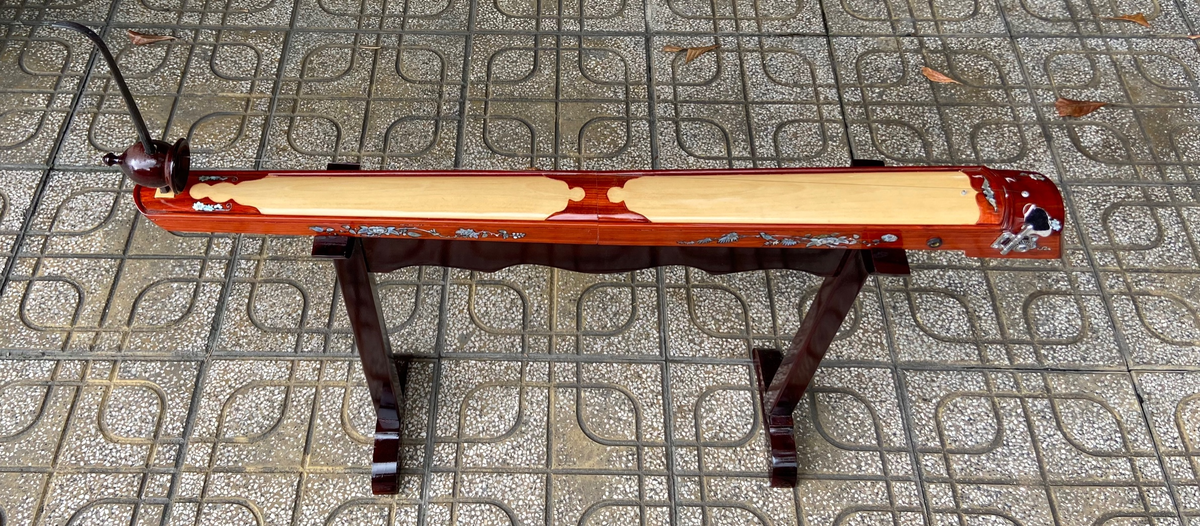
The body of the Dan Bau is a long, narrow box.
Traditionally, the body could be made from bamboo, bương, tre, or other locally available materials.
Later, wooden box constructions became increasingly common, particularly as the instrument entered professional musical environments.
The body has a slightly raised soundboard, while the surrounding sides are made from stronger wood.
The bottom is enclosed and may contain an opening associated with the string attachment and sound function.
The body is not simply a container.
It is part of the acoustic system.
The material, thickness, rigidity, internal volume, and soundboard all affect how efficiently the vibration of the string is transformed into audible sound.
This is why choosing the wood for a Dan Bau is not merely a matter of appearance.
WHY USE GO HUONG FOR THE BODY?
One of the most important features of the Dan Bau presented by Vietcraft.art is the use of go huong, or Vietnamese rosewood, for the main body.
The choice is not only aesthetic.
According to the source material, the body needs a material capable of providing structural stability while resisting the continuous tension generated by the metal string.
Go huong is valued for its density, strength, attractive grain, durability, and resistance to common problems associated with less stable woods.
Its reddish-brown or rose-brown appearance also provides a naturally rich background for traditional mother-of-pearl decoration.
The wood can have fine grain and a visual depth that becomes more pronounced after finishing.
The source material also emphasizes its characteristic fragrance and resistance to insects.
This creates an interesting contrast in the instrument.
The main body needs strength.
The soundboard needs responsiveness.
The decorative surface needs beauty.
The rod needs controlled flexibility.
The resonating system needs acoustic sensitivity.
A good Dan Bau is therefore not simply "made of wood."
Different parts of the instrument require different material characteristics.
That distinction is particularly important when discussing the go huong + go ngo dong construction.
WHY NOT MAKE THE ENTIRE DAN BAU FROM GO HUONG?
This is one of the most interesting questions about the instrument.
If go huong is strong, durable, beautiful, and valuable, why not use it everywhere?
Because strength and acoustic responsiveness are not necessarily the same thing.
The source material specifically emphasizes that the soundboard, or mat dan, should use a lighter, more responsive wood such as go ngo dong or another suitable lightweight wood rather than dense go huong.
The reason is acoustic.
The soundboard behaves somewhat like a vibrating membrane.
The string vibrates.
That vibration must be transferred efficiently into the soundboard.
The soundboard then interacts with the air inside and around the resonating body.
A very dense and heavy piece of wood is not automatically the best material for this job.
In the source's explanation, go ngo dong is lightweight, porous, and straight-grained, making it highly responsive to vibration.
This is why the combination of materials is so important:
Go huong provides the structural body.
Go ngo dong provides the responsive soundboard.
The two woods therefore perform different jobs.
This is a key detail that is often missed when people look at a Dan Bau only as a decorative object.
THE SOUND OF A DAN BAU BEGINS WITH THE SOUNDBOARD
The mat dan is one of the most acoustically important components.
It is the part that receives the vibration of the string and helps transmit that energy into the resonating body.
The source material compares its function to that of a natural loudspeaker membrane.
This is why lightweight wood with suitable grain structure is preferred.
If the soundboard is excessively heavy, dense, or acoustically unresponsive, the vibration may not be transferred efficiently.
The resulting sound can become dull or "closed."
This explains the apparently paradoxical construction:
A valuable instrument can require expensive dense wood for one part and lightweight soft wood for another.
The most expensive wood is not automatically the best wood for every component.
Each material is selected according to its function.
THE VOI DAN – THE CURVED ROD THAT CONTROLS THE VOICE
Perhaps the most visually distinctive component of the Dan Bau is the voi dan.
It is the curved rod extending upward from the body.
Traditional versions could use bamboo.
Other instruments use buffalo horn or other materials.
In the Dan Bau described in the source material, a carefully selected buffalo horn rod is especially valued for its mechanical elasticity.
Why does flexibility matter?
Because the musician repeatedly bends and releases the rod while playing.
The rod is not merely decorative.
It is the mechanism through which the performer continuously alters the tension of the single string.
Pulling or moving the rod changes the string's tension.
Changing tension changes pitch.
The player can therefore move between pitches without needing conventional frets.
This is the physical foundation of the Dan Bau's characteristic vocal quality.
WHY BUFFALO HORN?
The source material specifically emphasizes the mechanical elasticity of buffalo horn.
During techniques such as nhan, luyen, and other pitch-bending movements, the rod needs to flex repeatedly and return toward its original position.
A good rod therefore cannot simply be rigid.
It must be responsive.
It must be strong enough to withstand repeated movement.
And it must provide the player with a predictable physical response.
The source material contrasts buffalo horn with plastic or wood, emphasizing the former's flexibility and ability to recover its original form after repeated bending.
For a Western musician accustomed to fixed frets, this is a completely different way of thinking about pitch.
The player's hand is effectively part of the tuning mechanism.
THE BAU – THE RESONATING ELEMENT
The traditional Dan Bau was closely associated with the dried shell of a gourd.
This is where the name Dan Bau becomes especially meaningful.
The dried gourd served as a resonating component.
Other traditional materials could include coconut shell.
Later, wooden resonators and more developed acoustic constructions became common.
The source material describes the resonator as positioned where the rod passes through the body, while the string is stretched toward the rod.
This arrangement creates the characteristic geometry of the instrument.
The string is not simply laid parallel to the entire length of the body like the strings of a guitar.
Instead, it approaches the rod at an angle.
This unusual structure contributes to the visual identity of the Dan Bau.
THE STRING – ONLY ONE, BUT NOT SIMPLE
The Dan Bau has one primary vibrating string.
Modern instruments commonly use a metal string.
The string extends from the tuning mechanism at one end of the body toward the voi dan.
It passes through a small opening and is attached near the resonating element.
Because there is only one string, the entire expressive system of the instrument depends on how that string is activated and manipulated.
This makes the string simultaneously:
- the source of pitch,
- the source of harmonics,
- the carrier of expressive movement,
- and the central connection between the player's two hands.
A single string therefore becomes the entire melodic pathway.
THE TUNING MECHANISM
At the rear of the body is the tuning mechanism.
Traditional instruments could use wooden components, while modern instruments commonly incorporate metal tuning hardware.
The purpose is simple:
to establish and maintain the required tension of the string.
But because Dan Bau playing depends so strongly on precise pitch relationships, stable tuning is particularly important.
The source material notes that modern tuning mechanisms were improved to reduce unwanted slackening of the string.
THE PLECTRUM – QUE GAY
The right hand commonly uses a small plectrum known as a que gay.
The traditional plectrum could be made from bamboo, while modern versions may use cay giang, a material from the bamboo family.
Its dimensions affect the response of the instrument.
A plectrum that is too hard may catch or produce an undesirable attack.
A plectrum that is too soft may break or fail to produce the desired articulation.
The source material makes an interesting distinction between long and short plectrums.
A longer plectrum can create a stronger, fuller, more solid attack.
A shorter plectrum can provide a softer, more lyrical sound and is especially useful for faster modern techniques and tremolo.
Older practice could use a plectrum around 10 cm long, while modern performance often favors a much shorter plectrum of approximately 4–4.5 cm.
This small object therefore became part of the instrument's evolution.
FROM FOLK INSTRUMENT TO ELECTRIC DAN BAU
The Dan Bau did not remain frozen in its historical form.
As performance venues became larger, musicians needed greater volume.
This led to the development of electronic amplification.
A pickup or electromagnetic sensing component can be installed inside the instrument.
The vibration of the metal string is converted into an electrical signal, which is then sent to an amplifier and speaker.
This allowed the Dan Bau to move from intimate folk performance into professional stage environments.
The source material notes that modern instruments may include an electromagnetic pickup placed near the string and connected to amplification equipment.
At the same time, there remains an important distinction between the moc Dan Bau—an acoustically played instrument without electronic amplification—and the electric version.
Some listeners continue to prefer the natural acoustic sound because they perceive it as clearer and more natural.
THE FOLDING DAN BAU – TRADITION MEETS MODERN TRAVEL
One particularly interesting modern development is the folding Dan Bau.
Traditional Dan Bau instruments are relatively long.
That is beautiful from a traditional perspective but inconvenient for international transportation.
The folding design allows the instrument to be separated or folded into a more compact form for storage and travel.
When the musician wants to perform, the instrument can be reassembled.
This is not merely a cosmetic modification.
It addresses a practical problem faced by musicians, collectors, and international owners.
A long traditional instrument can be difficult to transport by air.
A folding construction makes the instrument much easier to carry while retaining the basic playing concept.
The source material specifically describes the folding design as one of the important modern improvements that allows the instrument to be disassembled and transported more conveniently.
For Vietcraft.art, this means the Dan Bau can exist in two practical forms:
Straight Dan Bau – closer to the traditional long-bodied format.
Folding Dan Bau – designed for easier storage and transport.
The difference is therefore practical rather than cultural.
Both belong to the same musical tradition.
THE ART OF KHAM TRAI – WHY DECORATE A DAN BAU WITH MOTHER-OF-PEARL?
A Dan Bau can be a musical instrument.
But in Vietnamese craftsmanship, it can also become a work of decorative art.
This is where kham trai, or mother-of-pearl inlay, enters the story.
The warm reddish-brown surface of go huong creates a dramatic background for pieces of shell and mother-of-pearl.
When viewed from different angles, mother-of-pearl can reflect green, pink, white, purple, and other iridescent tones.
This creates a striking contrast against the darker wood.
Traditional decorative themes may include:
- Tung – Cuc – Truc – Mai
- Vinh Quy Bai To
- traditional Northern Vietnamese village landscapes
- flowers and leaves
- symbolic natural imagery
The source material describes the process as involving the cutting or carving of grooves in the wood, preparing pieces of shell to fit those grooves, and carefully setting the decorative pieces into the body.
This is not simply painting.
It is an inlay technique.
The design becomes physically embedded in the wood.
That is why traditional mother-of-pearl inlay is so time-consuming.
The craftsman must create a precise relationship between:
wood → groove → shell piece → surface → polishing → final finish.
A small error can disrupt the pattern.
WHEN A MUSICAL INSTRUMENT BECOMES A PIECE OF FURNITURE-LIKE ART
The decorated Dan Bau occupies an interesting space.
It is neither merely an instrument nor merely a decorative object.
It remains a functioning musical instrument.
But its body may also display the visual vocabulary of Vietnamese traditional decorative arts.
This combination is especially visible in go huong Dan Bau with mother-of-pearl.
The body has structural responsibilities.
The soundboard has acoustic responsibilities.
The rod has mechanical responsibilities.
The inlay has artistic responsibilities.
Everything comes together in one object.
HOW A HANDMADE DAN BAU IS MADE
A traditional instrument is not simply assembled in one afternoon.
The source material proposes several important stages in the production process.
STEP 1 – SELECTING AND PREPARING THE WOOD
The wood must be selected according to its intended function.
Go huong is selected for the structural body.
Go ngo dong or another suitable lightweight wood is selected for the soundboard.
The wood needs to be properly dried and conditioned.
This is particularly important because wood changes dimension according to environmental conditions.
Poorly prepared wood may crack, warp, or become unstable.
The source material describes natural drying and seasoning over an extended period as part of preparation.
STEP 2 – BUILDING THE BODY AND SOUNDCHAMBER
The body is assembled so that its structure remains stable while allowing the soundboard to respond properly.
Traditional woodworking principles may be used in joining and edging the body.
The objective is not simply to produce a beautiful box.
The body must maintain the correct relationship between structural rigidity and acoustic response.
STEP 3 – INSTALLING THE SOUNDBOARD
The lightweight soundboard is carefully fitted to the body.
This is one of the stages where craftsmanship and acoustics meet.
Too much mass can reduce responsiveness.
Too little structural control can make the soundboard unstable.
The maker must therefore balance several competing requirements.
STEP 4 – INSTALLING THE VOI DAN
The curved rod is positioned through the body and resonating area.
Its alignment is critical.
The string must interact with it correctly.
The player must be able to move the rod smoothly.
A small change in geometry can affect the player's ability to control pitch.
STEP 5 – KHAM TRAI
Only after the basic wooden structure is properly prepared can the decorative inlay become part of the instrument.
The artisan prepares the design.
Grooves are made.
Mother-of-pearl pieces are shaped.
Each piece is fitted.
The surface is then finished and polished.
This is where a functional instrument begins to reveal its decorative identity.
STEP 6 – ACOUSTIC ADJUSTMENT
The instrument is then tested.
The string tension, soundboard response, rod movement, and harmonic response all need to work together.
For electric Dan Bau, the pickup is also positioned and tested.
The source material mentions testing pickup/string distance in the approximate range of 3–5 mm to avoid unwanted noise while maintaining sufficient signal strength.
This final stage is not simply "checking whether the instrument works."
It is the point at which the physical instrument becomes a playable musical system.
THE MOST IMPORTANT SECRET: BỒI AM – HARMONICS
Now we arrive at the heart of the Dan Bau.
The most extraordinary feature of the instrument is not simply that it has one string.
It is the way the musician uses bồi am, or harmonics.
The player does not always rely on the fundamental vibration of the string.
Instead, the string can be touched or activated at particular points—known as harmonic nodes—to produce higher partial tones.
The source material identifies positions such as:
1/2, 1/3, 1/4, 1/5, 1/6, 1/7, and 1/8
of the vibrating string.
These positions correspond to harmonic relationships.
The right hand produces the vibration while the player's technique determines how the harmonic is brought out.
The curved rod then allows the pitch of the resulting sound to be manipulated.
This is a remarkable combination:
harmonic selection + string tension + continuous pitch control.
That is the foundation of the Dan Bau's distinctive voice.
WHY DOES A DAN BAU SOUND LIKE A HUMAN VOICE?
This question is central to understanding the instrument.
Human speech is not made entirely of fixed pitches.
The voice rises.
It falls.
It bends.
It trembles.
It pauses.
It emphasizes.
It slides from one pitch toward another.
Vietnamese is also a tonal language.
The source material discusses the relationship between Vietnamese speech tones and traditional instrumental performance, particularly the ways in which melodic contours can interact with the six Vietnamese tones:
sac – huyen – hoi – nga – nang – khong.
This does not mean that the Dan Bau literally reproduces the six tones as six mechanical notes.
Rather, the expressive behavior of the instrument can reflect the pitch movement and inflection associated with Vietnamese speech and singing.
This is one reason the Dan Bau can sound remarkably vocal.
The performer is not simply pressing buttons to obtain notes.
The performer is shaping pitch continuously.
THE DAN BAU IS AN INSTRUMENT OF MELODY AND EMOTION
The source describes the Dan Bau as particularly suited to lyrical and expressive melodic performance.
In traditional Vietnamese music, it can serve as a principal melodic voice.
It may appear in:
- solo performance
- ensemble performance
- accompaniment for singers
- theatrical music
- traditional chamber music
- modern stage music
Its strength is not necessarily sheer volume or harmonic complexity.
Its strength is expressive pitch.
A single note can become a musical sentence.
A single pluck can be transformed through rung, luyen, lay, vo, vuot, and other techniques.
HOW THE TWO HANDS WORK TOGETHER
A beginner may see one hand plucking and another hand moving the rod.
But a professional musician is coordinating a remarkably complex system.
THE RIGHT HAND
The right hand can:
- pluck the string
- produce harmonics
- play in two directions
- perform tremolo or ve
- stop the string
- create bell-like sounds
- produce natural string tones
- create repeated attacks
- control articulation and rhythmic energy
Modern professional playing expanded the role of the right hand considerably.
The source specifically describes developments such as two-direction plucking, tremolo, stopping the string, harmonic techniques, natural tones, and bell-like sounds.
THE LEFT HAND
The left hand controls the voi dan and therefore controls pitch and expressive movement.
Techniques include:
- nhan
- luyen
- rung
- vo
- vuot
- lay
- chung
- cham
- giat
The left hand therefore has a particularly demanding role.
It is not merely "changing notes."
It is shaping the emotional character of those notes.
The source material emphasizes that the left hand is especially difficult because it must continuously control the string's tension while simultaneously executing expressive techniques.
NGON NHAN – PITCH BENDING
Nhan is one of the essential techniques of Dan Bau playing.
The performer manipulates the rod to increase string tension and therefore raise pitch.
This can create a controlled movement from one pitch toward another.
The technique is particularly important because traditional Vietnamese melodic expression often depends on pitch movement rather than rigidly fixed notes.
NGON CHUNG – LOWERING THE PITCH
The opposite movement involves reducing tension.
This allows the performer to lower the pitch.
The source describes chung as a technique capable of producing significant downward movement, depending on the elasticity of the rod and string.
This is another reason the material properties of the rod are so important.
The instrument must allow substantial pitch movement without losing control.
NGON LUYEN – THE ART OF SLIDING
Luyen can be understood by Western readers as a controlled pitch glide.
The musician moves from one pitch toward another rather than simply jumping between two fixed notes.
This is one of the techniques that contributes strongly to the vocal character of the Dan Bau.
It is particularly important in Vietnamese traditional music, where melodic expression frequently includes subtle pitch transitions.
NGON VUOT – THE GLIDING MOTION
With vuot, the performer moves along a pitch trajectory and arrives at the desired musical position.
Instead of treating every note as an isolated event, the technique emphasizes the journey between pitches.
This can make the line sound closer to singing.
NGON VỖ – THE EMOTIONAL IMPACT OF INTERRUPTION
Vo involves tapping or striking with the fingers in a manner that produces interrupted or rapidly changing pitch effects.
According to the source material, the technique can convey emotional states such as pain, frustration, suppression, or intense feeling.
This is a good example of how Dan Bau technique is inseparable from musical expression.
The same physical mechanism can have different emotional meaning depending on context.
NGON RUNG – THE FAMOUS DAN BAU VIBRATO
Perhaps no technique is more closely associated with the emotional voice of the Dan Bau than rung.
At first glance, rung may appear similar to vibrato on a Western string instrument.
But in Vietnamese traditional music, it has a much more specific stylistic function.
The performer rapidly manipulates the rod so that the pitch moves slightly above and below the central note.
The source describes rung as involving rapid alternation of nhan and chung, creating a wave-like fluctuation around the main pitch.
It can make the sound:
- warmer
- softer
- fuller
- more emotional
- more vocal
- more characteristic of a particular musical style
But rung is not simply an effect to be added everywhere.
A professional performer must know when to use it.
FOUR TYPES OF RUNG
The source material goes considerably deeper than simply dividing rung into "fast" and "slow."
It identifies four practical variations:
1. Fast rung with narrow amplitude
A quick, restrained fluctuation.
It can create a gentle, controlled emotional quality.
2. Fast rung with wide amplitude
A stronger and more pronounced fluctuation.
The source associates this type with emotional states such as agitation, anger, or resentment.
3. Slow rung with narrow amplitude
A slower and restrained movement.
This can create a softer and calmer emotional color.
4. Slow rung with wide amplitude
A broader, slower movement associated with a more sorrowful or deeply emotional character.
These differences may appear subtle to an inexperienced listener.
To an experienced performer, however, they can completely change the character of a phrase.
RUNG DEPENDS ON MUSICAL STYLE
One of the most important lessons in the source material is that there is no universal "correct vibrato" for every Dan Bau performance.
The performer must understand the musical style first.
Cheo
In Cheo, rung is often relatively moderate, soft, and light.
But depending on the emotional character of the passage, it can become faster or slower.
Hue music
Different styles within Hue music require different approaches.
The source describes distinctions associated with Hoi Nam and Hoi Bac, including differences in the speed and strength of rung.
Cai Luong
The same principle applies.
Different melodic styles require different types of rung.
The performer must understand the musical phrase before deciding how the note should vibrate.
This is one of the reasons that simply learning the mechanical technique of Dan Bau is not enough.
One must learn the musical language behind the technique.
RUNG IS NOT SUPPOSED TO BE USED EVERYWHERE
This point is particularly important when Dan Bau is used to perform Western compositions.
The source gives examples of foreign works adapted for Dan Bau.
When a Western melody is gentle and does not contain many Vietnamese-style pitch ornaments, the performer may need to use rung much more carefully.
Too much rung can unintentionally transform the piece into a strongly Vietnamese traditional-style performance.
This is why professional Dan Bau playing requires stylistic awareness.
The instrument is capable of many expressive effects.
The musician's art lies partly in knowing when not to use them.
THE DAN BAU AND VIETNAMESE FOLK SONG
Learning Vietnamese folk songs is an important foundation for Dan Bau performance.
The source explains that folk songs from the three major regions of Vietnam provide students with accessible melodies and gradually teach them how to absorb regional musical characteristics.
The goal is not merely to reproduce notes.
The player must gradually become familiar with the "color" or musical character of a region.
Through repeated exposure, the musician learns how the melody should breathe, where pitch should bend, how long a note should be held, and how a particular ornament should be used.
This is why traditional performance cannot be fully understood through Western notation alone.
DAN BAU AND CHEO
Cheo is one of Vietnam's traditional theatrical forms.
Music plays a central role in shaping characters, emotions, dramatic situations, and the atmosphere of a performance.
The source material emphasizes an important feature of Cheo performance:
Musicians do not always behave like mechanical performers reading fixed notes.
They respond to the rhythmic and melodic structure of the traditional piece.
Different instruments can interpret the same melodic material differently according to their own expressive possibilities.
The Dan Bau is particularly interesting because its performance style can resemble singing.
A note may be plucked once and then transformed through luyen, lay, nhan, and rung.
The instrument can therefore imitate the contour of a sung phrase.
This is one of the reasons the Dan Bau is so closely associated with the human voice.
DAN BAU AND HUE MUSIC
Traditional Hue music has its own tonal and stylistic characteristics.
The source material emphasizes that performers must understand the relevant scale and pitch behavior rather than simply forcing traditional melodies into the equal-tempered system familiar from Western instruments.
This is especially important for Dan Bau because its ability to continuously bend pitch allows the performer to reproduce subtle regional characteristics.
In other words, the flexibility of the instrument becomes an advantage.
A fixed-pitch instrument may have difficulty reproducing a pitch that lies between two Western semitones.
The Dan Bau can move into that space.
That ability is one of the reasons it is so well suited to traditional Vietnamese melodic language.
DAN BAU AND ĐỜN CA TÀI TỬ
In Dan Ca Tai Tu, melodic styles are associated with different Hoi categories.
The source discusses Hoi Bac, Hoi Nam, and Hoi Oan.
The same nominal pitch can take on a different expressive character depending on how it is treated.
For example, the combination of rung, lay, and other techniques can help distinguish the character of one melodic style from another.
This demonstrates an important principle:
A musical note is not only a frequency.
In traditional Vietnamese music, the way a note is approached, sustained, ornamented, and released can be just as important as the nominal pitch itself.
DAN BAU AND CAI LUONG
Cai Luong, the southern Vietnamese reformed theatre tradition, also provides a rich environment for Dan Bau performance.
Its musical language includes different melodic styles and emotional colors.
The source material compares Vietnamese and Chinese pieces that may have similar names while emphasizing that their performance traditions, tempos, melodic treatment, and ornamentation can be different.
This is an important reminder that musical terminology alone does not define musical identity.
Performance practice matters.
The same title does not necessarily mean the same musical language.
DAN BAU AND XAM
Perhaps the most emotionally powerful chapter in the Dan Bau story is its connection with Xam.
Xam was traditionally associated with itinerant singers, including blind performers in northern Vietnam.
The Dan Bau could accompany the singer and help communicate stories of hardship, longing, loneliness, love, and everyday life.
This historical association contributed to the emotional reputation of the instrument.
The Dan Bau was not originally imagined as a concert-hall luxury instrument.
It belonged to ordinary people.
It traveled.
It was played in village environments.
It accompanied voices.
And its sound became associated with the emotional life of people who had very little material wealth.
The source materials repeatedly return to this relationship between Dan Bau and Xam.
FROM THE XAM MAT TO THE PROFESSIONAL STAGE
The transformation of the Dan Bau is remarkable.
It moved from:
folk instrument → accompaniment instrument → ensemble instrument → professional solo instrument → modern stage instrument → internationally presented cultural instrument.
As Vietnam developed formal music institutions, the Dan Bau entered professional education.
The source material identifies 1956, when the Vietnam School of Music was established, as an important point in the development of professional Dan Bau education.
From that point, musicians could study not only the instrument informally but also through organized training.
This changed the instrument's social and artistic position.
LEARNING DAN BAU IS NOT SIMPLY LEARNING NOTES
A professional student of Dan Bau must learn much more than fingering.
The source material describes a combination of:
- Western-style staff notation
- traditional oral transmission
- transmission of playing techniques
- study of folk songs
- study of traditional music
- study of Cheo
- study of Hue music
- study of Tai Tu and Cai Luong
- ensemble practice
- performance practice
This is important because traditional Vietnamese music often contains details that cannot be fully communicated through a written score.
A teacher may need to demonstrate:
- exactly how a note is bent
- exactly how wide a rung should be
- how quickly the pitch moves
- where the phrase should breathe
- how a particular regional style should sound
This is why the source describes truyen khau and truyen ngon—oral and technique-based transmission—as important components of Dan Bau education.
THE DIFFERENCE BETWEEN TECHNIQUE AND ART
This may be the most important lesson in the entire story.
A person can learn how to move the rod.
A person can learn how to pluck the string.
A person can learn where harmonic nodes are located.
A person can learn how to produce rung.
But that does not automatically mean the person can play Vietnamese traditional music convincingly.
Technique becomes art only when it is placed inside the correct musical context.
The source material makes this distinction repeatedly.
A performer must understand:
the song,
the style,
the regional character,
the emotional content,
the melodic structure,
and only then decide how the technique should be applied.
That is why professional Dan Bau playing can take years of study.
DAN BAU IN MODERN MUSIC
The Dan Bau did not stop evolving when it entered professional education.
New compositions were written for it.
Existing Vietnamese folk melodies were arranged for larger ensembles.
Foreign works were adapted.
The instrument appeared with orchestras.
The right hand developed new techniques.
The left hand became increasingly sophisticated.
The source material describes modern developments including:
- two-direction tremolo
- two-direction plucking
- playing multiple notes
- string release techniques
- stronger rhythmic articulation
- expanded expressive vocabulary
These techniques allow the instrument to move beyond its earlier role as a quiet accompaniment instrument.
It can now produce:
- delicate lyrical sound
- energetic rhythmic sound
- dramatic sound
- melancholy
- tension
- excitement
- powerful stage expression.

THE DAN BAU AND WESTERN MUSIC
The Dan Bau can also perform melodies originating outside Vietnam.
This demonstrates another remarkable characteristic of the instrument.
Its physical mechanism does not prevent it from playing foreign melodies.
However, the performance style may need to change.
A Vietnamese traditional melody may require extensive ornamentation.
A Western classical melody may require much cleaner pitch and more restrained ornamentation.
The source specifically emphasizes that when adapting foreign compositions, performers must be careful with luyen, lay, and rung, because excessive use can unintentionally give the music a strongly Vietnamese traditional character.
This is an important lesson in cultural translation.
The instrument can cross musical borders.
But the performer must understand the musical language being performed.
THE DAN BAU AND IMPROVISATION
Modern Dan Bau performance can also include improvisation.
The source identifies different forms of improvisational practice.
One approach works within a harmonic framework.
Another uses a thematic idea and allows the performer greater freedom to create melodic material.
This is particularly interesting because the Dan Bau's continuous pitch control gives the musician an enormous range of expressive possibilities.
The player is not restricted to mechanically reproducing fixed pitches.
The player can create trajectories.
That makes the instrument particularly suitable for expressive improvisation.
ONE STRING, MANY MUSICAL WORLDS
The Dan Bau has appeared in a remarkable variety of Vietnamese musical environments:
Xam
Cheo
Tuong
Water Puppetry
Hue chamber music
Dan Ca Tai Tu
Cai Luong
folk song
traditional ensembles
modern compositions
orchestral collaborations
This journey is important because it shows that the Dan Bau is not tied to one historical moment.
It has continually adapted.
OTHER ONE-STRING INSTRUMENTS AROUND THE WORLD
Vietnam is not the only country with a one-string instrument.
This makes the Dan Bau even more interesting.
In China there are instruments referred to as Yixian Qin or Duxian Qin traditions.
Japan has the Ichigenkin.
Cambodia has the Sadev.
India has the Gopi Yantra.
Africa also has several one-string traditions.
Ancient Greece used a monochord-like instrument in connection with the study and measurement of musical intervals.
So the number "one" does not belong exclusively to Vietnam.
What makes the Dan Bau distinctive is the particular combination of:
one string + harmonics + flexible rod + continuous pitch control + Vietnamese musical ornamentation.
The source material emphasizes that these instruments may share the one-string principle while differing greatly in construction, playing method, sound production, and musical function.
THE SPECIAL ROLE OF BỒI AM
Many one-string instruments rely primarily on the fundamental or direct vibration of their string.
The Dan Bau developed an especially sophisticated use of harmonics.
The player can excite a harmonic at a specific point along the string and then manipulate the resulting pitch through the flexible rod.
This creates a sound that can feel simultaneously:
pure and complex,
simple and mysterious,
bright and melancholic.
The harmonic system is therefore not a technical curiosity.
It is central to the identity of the instrument.
WHY THE DAN BAU CAN SOUND BETWEEN THE NOTES
A piano has fixed keys.
Once a piano is tuned, the performer presses a key and receives a predetermined pitch.
The Dan Bau behaves differently.
Its pitch can move continuously.
This means the musician can reach spaces between the fixed notes familiar to Western listeners.
This is particularly useful for Vietnamese traditional music because expressive pitch is often more flexible than the twelve-tone equal-tempered system used in much Western music.
The Dan Bau therefore possesses a physical mechanism that naturally supports pitch inflection.
This is one of its greatest expressive advantages.
THE DAN BAU AS A VOICE WITHOUT WORDS
Perhaps the most beautiful way to understand the instrument is to think of it as a voice without language.
A singer has:
- pitch
- breath
- vibrato
- slides
- accents
- pauses
- emotional intensity
The Dan Bau has:
- string tension
- harmonics
- rod movement
- plucking
- rung
- luyen
- lay
- vo
- vuot
The vocabulary is different.
The expressive principle is surprisingly close.
This is why the Dan Bau can sound like it is speaking even though it has no words.
THE DAN BAU AS A SYMBOL OF VIETNAM
Over time, the Dan Bau became more than a musical instrument.
For many Vietnamese people, its sound evokes homeland.
It can evoke:
- village life
- bamboo
- rice fields
- folk songs
- family
- childhood
- separation
- longing
- love
- memory
The source material includes the famous poetic image:
“Dat nuoc toi thon tha giot Dan Bau”
“The country of mine is slender like a drop of Dan Bau.”
The metaphor is powerful.
Vietnam's geographic shape is often imagined as long and graceful.
The Dan Bau's body is also long and slender.
Its sound travels through emotional spaces that words sometimes cannot reach.
THE DAN BAU IS NOT JUST ABOUT SOUND
It is also about memory.
For Vietnamese listeners, the sound can evoke a landscape.
For someone who grew up far from Vietnam, it can evoke home.
For a musician, it can represent a technical challenge.
For an artisan, it represents a craft tradition.
For a collector, it can become a tangible connection to Vietnamese culture.
For an international listener encountering it for the first time, it can raise a question that has no simple answer:
How can one string sound like a human voice?
Perhaps the most satisfying answer is:
Because the instrument is only half of the music.
The other half is the person playing it.
ONE STRING. ONE VOICE. A THOUSAND SHADES OF EMOTION.
The Dan Bau teaches an unusual lesson about musical instruments.
More strings do not necessarily mean more expression.
More mechanisms do not necessarily mean more emotion.
Sometimes an instrument becomes powerful precisely because it leaves space for the human hand.
The Dan Bau gives the performer one string.
The performer gives that string movement.
Movement becomes pitch.
Pitch becomes melody.
Melody becomes expression.
Expression becomes memory.
And memory becomes culture.
That is why the Vietnamese Dan Bau continues to occupy such a special place in the musical imagination of Vietnam.
It may have only one string.
But that one string has been asked to carry an extraordinary amount of history.
DISCOVER THE VIETNAMESE DAN BAU AT VIETCRAFT.ART
At Vietcraft.art, the Vietnamese Dan Bau is presented as part of a wider collection of traditional Vietnamese cultural and musical instruments.
The Dan Bau go huong kham trai, available in straight and folding versions, brings together traditional musical principles and Vietnamese craftsmanship.
The folding model is particularly practical for international owners because its compact design makes storage and transportation easier.
The straight model preserves the familiar long-bodied appearance of the traditional instrument.
Whichever form you choose, the essential idea remains the same:
a Vietnamese musical instrument built around one string, harmonics, controlled pitch movement, and a remarkably expressive human touch.
If you are discovering Vietnamese traditional music for the first time, the Dan Bau is one of the most fascinating places to begin.
Explore the Vietnamese Dan Bau at Vietcraft.art and discover the story behind the sound.
FINAL THOUGHT
A country can be remembered through its architecture.
It can be remembered through its food.
It can be remembered through its literature.
But sometimes a country can also be remembered through a single sound.
For Vietnam, that sound can be the voice of the Dan Bau.
A single string stretches across a wooden body.
A small plectrum touches it.
A curved rod moves.
A harmonic appears.
The pitch bends.
And suddenly, something that looks almost impossibly simple begins to speak.
One string.
One voice.
A thousand shades of emotion.
That is the story of the Vietnamese Dan Bau.
Explore More Vietnamese Traditional Musical Instruments
The Dan Nguyet (Vietnamese Moon-Shaped Lute) is only one voice in the rich and diverse world of Vietnamese traditional music.
Across Vietnam, different instruments have developed their own sounds, techniques, shapes, and cultural stories. Some are melodic instruments, some create rhythm, and others help shape the musical atmosphere of traditional singing, theatre, rituals, and community performances.
If discovering the Dan Nguyet has made you curious about the wider world of Vietnamese traditional music, continue exploring these instruments at vietcraft.art:
Dan Nguyet (Vietnamese Moon-Shaped Lute)
The two-stringed, moon-shaped instrument at the heart of this story, known for its expressive pitch bending, vibrato, ornamentation, and distinctive traditional sound.
Dan Bau (Vietnamese Monochord)
Discover the remarkable Vietnamese one-string instrument known for its expressive pitch changes and distinctive sound.
Dan Tranh (Vietnamese Zither)
Explore the traditional Vietnamese plucked zither and its delicate melodies, pitch bending, ornamentation, and long history in Vietnamese music.
Dan Nhi (Vietnamese Two-String Fiddle)
Discover the expressive bowed instrument whose sound can closely resemble the emotional qualities of the human voice.
Trong De (Vietnamese Traditional Folk Drum)
Explore the small Vietnamese folk drum and its connections with traditional performance, children's activities, festivals, and cultural celebrations.
Thanh La (Vietnamese Brass Percussion)
Discover the bright metallic sound of this traditional Vietnamese percussion instrument and its role in musical ensembles.
Tiu and Canh (Vietnamese Traditional Brass Percussion)
Explore the contrasting sounds of these traditional brass percussion instruments and their place within Vietnamese musical performance.
Phach Tre (Vietnamese Bamboo Clappers) and Canh (Small Brass Gong)
Discover the fascinating combination of bamboo rhythm and bright brass percussion, encountered in different Vietnamese traditional singing and musical traditions.
Trong Ban (Vietnamese Traditional Drum)
Explore another example of the important role of drums and percussion in Vietnamese traditional music, helping establish rhythm, accents, and musical atmosphere.
Sao Truc (Vietnamese Bamboo Flute)
Discover the clear, lyrical voice of the Vietnamese bamboo flute and its connection with traditional music and the natural imagery of Vietnam.
Each of these instruments tells a different story.
Some speak through strings.
Some speak through bamboo.
Some speak through metal.
Some speak through the deep pulse of a drum.
Yet together they reveal something larger:
Vietnamese traditional music is not one sound, but a conversation between many different voices.