Vietcraft.art
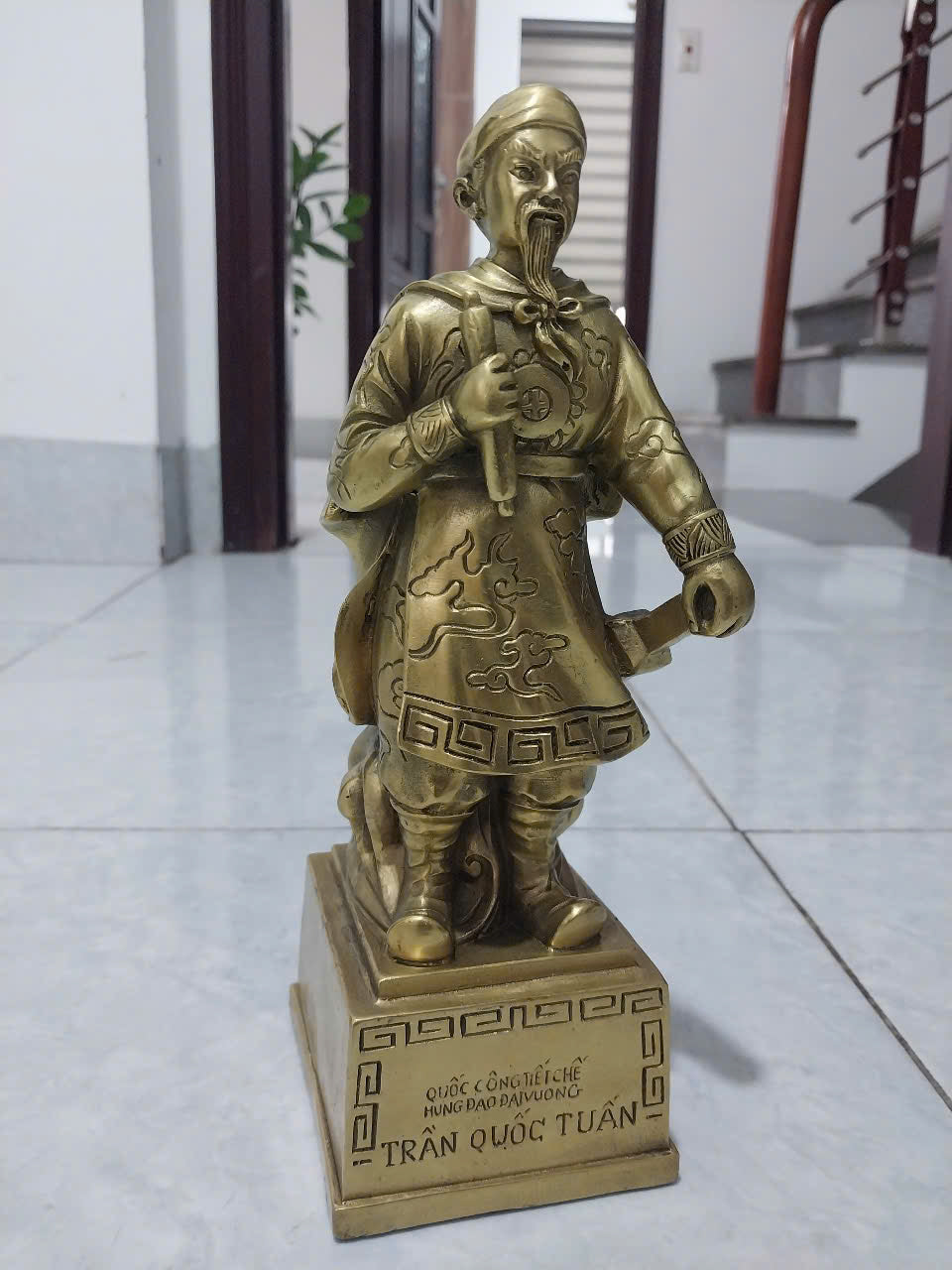
Tran Hung Dao Bronze Statue – Vietnamese Historical Sculpture.
Tran Hung Dao Bronze Statue – Vietnamese Historical Sculpture.
Couldn't load pickup availability
1. MEET YOUR TRAN HUNG DAO STATUE – A BRONZE TRIBUTE TO VIETNAMESE HISTORY
Honor a celebrated figure in Vietnamese history with this 23 cm bronze statue of Tran Hung Dao, also known as Hung Dao Dai Vuong Tran Quoc Tuan. Made in Vietnam, the sculpture features decorative detailing and a base engraved with his name.
Its compact size makes it suitable for a study, office, or personal collection of Vietnamese heritage pieces.
Product Details
- Subject: Tran Hung Dao – Tran Quoc Tuan
- Material: Yellow bronze
- Height: 23 cm
- Base detail: Engraved name
- Origin: Vietnam
Who It’s For
A meaningful choice for collectors of historical sculpture, those with a connection to Vietnamese heritage, or anyone seeking a commemorative gift.
Material & Finish Notice
This listing describes a yellow-bronze statue. Gold plating is not specified as an included feature. If a particular finish is important to you, please confirm the available piece before ordering.
Care
Remove dust with a soft, dry cloth. Avoid abrasive materials, harsh chemical cleaners, and prolonged exposure to moisture.
Shipping & Import Charges
Import duties and import taxes covered by Vietcraft.art.
We ship from Vietnam and cover import duties and import taxes for all shipping options listed below, including express shipping and heavy or bulky items. Shipping fees are separate from the product price.
For small, lightweight items, our preferred shipping services are USPS for deliveries to the United States, and Royal Mail or YunExpress for deliveries to the European Union. Heavy or bulky items shipped to the United States or European Union must use express shipping services such as UPS, FedEx or DHL. Items exceeding ePackage size limits must also use express shipping.
Standard Shipping to the United States
- Carrier: USPS
- Estimated delivery: 14–28 days
- Import duties and import taxes: Covered by Vietcraft.art
Standard Shipping to the European Union
- Carrier: Royal Mail or YunExpress
- Estimated delivery: 16–30 days
- Import duties and import taxes: Covered by Vietcraft.art
Express Shipping to the United States & European Union
- Carrier: UPS, FedEx or DHL
- Estimated delivery: 10–18 days
- Import duties and import taxes: Covered by Vietcraft.art
Please Note
Available shipping methods depend on your destination and the packed parcel’s weight and dimensions. Standard shipping is not available for heavy, bulky or oversized items. Delivery times are estimates, not guaranteed arrival dates, and may vary due to customs processing and local delivery conditions.
2. THE STORY BEHIND YOUR TRAN HUNG DAO STATUE – COURAGE, STRATEGY, AND THE HERITAGE OF DAI VIET
Feng Shui Significance
The Tran Hung Dao Statue is not just a decorative piece but also carries deep feng shui significance, representing the power to protect, ward off negative energies, and guard the home. It brings peace, good fortune, and prosperity to the family.
Similar to the Guan Gong statue in Chinese culture, which depicts a revered historical military figure, the Hung Dao Dai Vuong statue symbolizes loyalty, patriotism, and the sustainable strength of the Dai Viet nation. Dai Viet was the historical name of Vietnam during this period.
Placement and Maintenance
To maximize its feng shui benefits, the statue should be placed in the living room or office, on a table, wooden pedestal, or high shelf, facing the main entrance, and away from impure areas like bathrooms, bedrooms, kitchens, or dark corners.
If intended for worship, it should be placed in a solemn, respectful space, chosen on an auspicious date and time.
History and Tradition
Hung Dao Dai Vuong is an honorific title associated with Tran Quoc Tuan, the Vietnamese military commander widely known as Tran Hung Dao. He is a symbol of the patriotism and military genius of the Dai Viet people. He led his forces to victory against the renowned Mongol Yuan invasions three times, defending the independence and sovereignty of Dai Viet.
He left behind outstanding military works such as “Binh Thu Yeu Luoc” (Essentials of Military Strategy) and “Van Kiep Tong Bi Truyen Thu” (Secret Teachings of Van Kiep), which contributed greatly to Vietnamese military art and earned him the deep respect and veneration of later generations as a saintly figure.
How Tran Hung Dao Defeated the Mongol Yuan Invasions Three Times
With his impressive victories against the Mongol Yuan invaders, Tran Hung Dao became a renowned general, honored in the hearts of the Vietnamese people.
To fully understand the historic battles of Tran Hung Dao against the Yuan Mongol forces, we need to explore the historical context and the clever military strategies he employed. The Yuan was the Mongol-led dynasty that ruled China during this period.
Tran Hung Dao and the Story of Enduring the Enemy’s Provocation
During a diplomatic encounter with the Yuan envoy Sai Thung, Hung Dao Dai Vuong remained composed even as he was insulted. In front of Sai Thung, he calmly sat down, brewed tea, and drank with him.
Later, one of Thung’s servants recognized him and struck him on the head with an arrow, causing him to bleed, yet Tran Quoc Tuan’s expression did not change. Upon departing, Sai Thung personally saw him off at the door.
This incident was recorded in the “Dai Viet Su Ky Toan Thu” (Complete Annals of Dai Viet), a Vietnamese historical chronicle.
The Philosophy of Warfare According to Tran Hung Dao
Following this encounter, the Yuan Dynasty attempted to invade Dai Viet. Under the leadership of Hung Dao Dai Vuong Tran Quoc Tuan, the Vietnamese army and people completely defeated the invading forces.
Reflecting on his military philosophy, he wrote in the “Binh Thu Yeu Luoc”:
“A true strategist wins not by many battles, but by ensuring total victory.”
This principle emphasized the importance of a decisive final victory.
Strategic Mastery and the “Empty City” Tactic
Understanding that direct confrontation against the powerful Yuan forces was not always the best approach, Tran Hung Dao adopted a flexible strategy, avoiding strong positions and attacking the enemy’s weak points.
During the third invasion in 1287–1288, he famously used the “Empty City” tactic, retreating from the capital Thang Long, the historical name of Hanoi, and leaving it abandoned to confuse and demoralize the invading forces.
This approach effectively stretched the Yuan supply lines and exhausted their troops, leading to their eventual defeat.
The Power of Unified People
He also emphasized the critical role of unified people in warfare, writing:
“The shape of the formation is like the character ‘人’ (human). Advancing is like the character ‘人’, retreating is like the character ‘人’. Gathered together, they form one person; scattered, they remain one person. One person makes one battle, a thousand or ten thousand people together make one battle, a thousand or ten thousand moving together make one battle.”
Bach Dang 1288 – The Legendary Naval Battle of the Vietnamese Nation and Command of Quoc Cong Tiet Che Tran Hung Dao
The Bach Dang battle, which took place in the spring of 1288 on the Bach Dang River in northern Vietnam, is considered the greatest naval battle in Vietnamese history. It completely defeated the third invasion of Dai Viet by the Yuan army.
Under the leadership of Thai Thuong Hoang Tran Thanh Tong, the retired emperor, and King Tran Nhan Tong, the reigning emperor, together with the supreme command of Quoc Cong Tiet Che Tran Hung Dao, whose title reflected his senior military authority, the army and people of Dai Viet inflicted devastating losses on the Yuan forces: approximately 40,000 soldiers were eliminated from combat, 400 warships were destroyed, the naval commander Truong Ngoc was killed, and prominent Yuan generals such as O Ma Nhi, Phan Tiep, and Ao Lo Xich were captured alive.
The Yuan Advance and Retreat
At the end of 1287, the Yuan Empire launched its third invasion of Dai Viet. The campaign was commanded by Prince Tran Nam Vuong Thoat Hoan (Togoon), the ninth son of Emperor Nguyen Hot Tat Liet (Kublai Khan). Tran Nam Vuong was the prince’s title; Thoat Hoan was the Vietnamese rendering of his name.
According to Yuan historical records, the invading force consisted of about 92,000 troops and 500 warships.
After several engagements during the invasion, the Tran dynasty court strategically withdrew from Thang Long and implemented the “scorched-earth” strategy, leaving the capital empty to deny resources to the enemy.
Meanwhile, the Yuan supply fleet traveling by sea was completely destroyed at the Van Don battle by forces commanded by Nhan Hue Vuong Tran Khanh Du, a Vietnamese commander whose name was Tran Khanh Du and whose title was Nhan Hue Vuong.
Yuan chronicles recorded the loss of eleven ships and over 14,300 units of grain, while An Nam Chi Luoc, a historical account concerning Vietnam, states that Truong Van Ho, the Yuan supply fleet commander, escaped with only a single vessel.
The victory at Van Don played a decisive role in the resistance campaign, leaving the invading army without sufficient supplies and placing it in a critical logistical situation.
As summer approached, intense heat and humidity severely affected the Yuan troops. Facing mounting difficulties, Yuan commanders proposed withdrawal to China.
Historical sources recorded their assessment: Dai Viet had no fortified cities to occupy, no food supply remained, and the climate exhausted the army.
Thoat Hoan ultimately agreed to retreat. Debate arose regarding the withdrawal strategy. Some generals suggested abandoning ships and returning overland, but the final decision divided the forces into both naval and land columns.
Unbeknownst to them, they were moving directly into a carefully prepared trap organized by Tran Hung Dao and the Dai Viet forces.
Luring the Enemy into the Trap
On the 27th day of the second lunar month (30 March 1288), Thoat Hoan ordered O Ma Nhi and Phan Tiep, commanders of the Yuan naval forces, to lead the naval fleet in advance.
Cavalry units under the Yuan commanders Trinh Bang Phi and Ta Tru were assigned to escort them, but destroyed bridges and roads prevented effective coordination, forcing the cavalry to turn back.
The Yuan fleet, already exhausted from months of continuous fighting, was repeatedly harassed by Dai Viet forces. Without escort support, the fleet advanced slowly.
On 8 April 1288, it reached Truc Dong on the Gia River and encountered fierce resistance. The Yuan fleet was forced to redirect through the Da Bach River toward the Bach Dang River.
The successful defense at Truc Dong prevented enemy penetration into the Gia River, where Dai Viet naval forces were secretly positioned for a flank attack.
This engagement protected the hidden ambush battlefield at Bach Dang, personally commanded by Hung Dao Vuong Tran Quoc Tuan, another form of Tran Hung Dao’s title and name.
Preparation of the Tran Dynasty Forces
Research indicates that Tran Hung Dao constructed a massive ambush system along the Bach Dang River. Large wooden stakes were driven deep into the riverbed and concealed beneath water and vegetation.
These stakes were prepared earlier, likely during operations around Truc Dong and An Bang, locations associated with the campaign. Local inhabitants actively assisted soldiers in harvesting timber and installing the stake field.
Archaeological discoveries made in 1953–1954 at Yen Giang revealed hundreds of preserved stakes, mostly made of ironwood and tau wood, measuring from 1.5 meters to over 2.5 meters in length with diameters between 18 and 28 centimeters.
Historical evidence suggests the stakes were not fitted with iron tips.
Tran forces deployed infantry within the limestone mountains of Trang Kenh and dense forests along the left bank of the Bach Dang River, while naval units concealed themselves in tributaries such as the Gia River, Thai River, and Dien Cong River.
The Course of the Battle
At dawn on the 8th day of the third lunar month (9 April 1288), the fleet of O Ma Nhi and Phan Tiep entered the Bach Dang River during high tide, which concealed the submerged stakes.
Tran naval forces launched a feigned attack and deliberately retreated. The Yuan fleet pursued aggressively.
As the tide receded, enemy ships became impaled on the stake field, causing formation collapse. Numerous vessels were damaged or sunk.
Ambush forces then attacked simultaneously from both riverbanks and the rear. Historical chronicles describe massive casualties among the Yuan forces, with the river waters turning red from blood.
Over four hundred enemy ships were captured. General Nguyen Khoai, a Vietnamese commander, seized the Yuan officer Ao Lo Xich, while Do Hanh, another Vietnamese commander, captured O Ma Nhi and presented him to the former emperor.
The battle raged until evening. Yuan sources confirm that by dusk the entire fleet had been annihilated.
Results of the battle included:
- Naval commander Truong Ngoc killed in action
- Phan Tiep wounded and captured
- O Ma Nhi captured alive
- Numerous Mongol nobles and officers taken prisoner
- More than 400 warships captured or destroyed
Collapse of the Invasion
The Yuan land army retreating under Thoat Hoan toward Lang Son, in northern Vietnam near the border with China, suffered repeated ambushes along mountain passes such as Noi Bang, sustaining heavy casualties.
General A Ba Tri, a Yuan commander, was killed by a poisoned arrow. The remnants reached Tu Minh on 19 April 1288.
On the 17th day of the third lunar month (18 April 1288), Thai Thuong Hoang Tran Thanh Tong and King Tran Nhan Tong returned to Long Hung Palace and conducted a victory ceremony, presenting captured commanders before the mausoleum of King Tran Thai Tong, an earlier Tran emperor who had led the victory against Mongol forces in 1258.
Moved by the triumph, Tran Nhan Tong composed the famous lines:
“Xa tac luong hoi lao thach ma
Son ha thien co dien kim au”(The nation twice shook the stone horses,
Yet mountains and rivers endure forever in golden stability.)
Ten days later, on 28 April 1288, the royal court returned to the devastated capital Thang Long and proclaimed a general amnesty, exempting taxes and labor duties for regions ravaged by war.
Thoat Hoan, upon returning to meet Emperor Nguyen Hot Tat Liet, faced imperial anger, was exiled to Duong Chau, and forbidden from future audiences for life.
Tran Quoc Tuan and the Bach Dang Campaign
Tran Quoc Tuan was born in 1228 into the royal Tran dynasty lineage. Throughout his life, he faithfully served four prosperous Tran kings.
He was regarded as a pillar of the nation, embodying both exceptional military talent and noble virtue.
During the Bach Dang campaign of 1288, he personally traveled to the Trang Kenh region and surrounding villages to organize defensive formations aimed at intercepting the withdrawing Yuan forces.
Historical Significance
The Bach Dang victory of 1288 represents the pinnacle of military strength and strategic art of Dai Viet in the 13th century.
It demonstrated the extraordinary strategic genius of Hung Dao Dai Vuong Tran Quoc Tuan — an outstanding national hero and brilliant military strategist.
He is revered by the Vietnamese people as a sacred national figure and is also recognized internationally as one of the greatest military commanders in history.
Today, on the historic Bach Dang River, near the mouth of the Thai River flowing into Bach Dang, stands the Bach Dang Giang Historical Site.
This memorial complex commemorates the three great victories against foreign invaders on the Bach Dang River and expresses gratitude from later generations toward national heroes who contributed greatly to the country and its people:
- Duc Vuong Ngo Quyen: the revered Vietnamese ruler Ngo Quyen.
- Hoang De Le Dai Hanh: Emperor Le Dai Hanh.
- Hung Dao Dai Vuong Tran Quoc Tuan: the military leader known as Tran Hung Dao.
- Chu Tich Ho Chi Minh: President Ho Chi Minh.
The site stands as a lasting tribute to the enduring spirit, independence, and resilience of the Vietnamese nation.
Share