Vietcraft.art
Smoked Bamboo Roots Vertical Flute C4 with Eight Holes, Vietnamese Name: Tieu Bat Khong
Smoked Bamboo Roots Vertical Flute C4 with Eight Holes, Vietnamese Name: Tieu Bat Khong
Couldn't load pickup availability
Smoked Bamboo Roots Vertical Flute C4 with Eight Holes
Vietnamese Name: Tieu Bat Khong
PRODUCT DESCRIPTION
The Smoked Bamboo Vertical Flute C4 - Tieu Bat Khong is a meticulously handcrafted product. The material used for the flute is carefully selected and processed: Cao Bằng bamboo is cut, bent, and smoked for a period to achieve a natural and permanent color. This enhances the aesthetics and provides resistance to termites and mold.
The flute is natural and unpainted, without any chemicals, ensuring 100% health safety. The longer you play the flute, the better the sound quality and the more naturally glossy it becomes. It is crafted with precision by artisans with nearly 10 years of experience in the field.
With many years of experience in producing flutes, our products meet the following criteria:
- Accurate sound
- Aesthetic appeal
- Easy to blow (a very important factor). The flute can have a cap or not, and the blowing method is the same, making it easy to produce sound.
- Smooth pitch transitions and rhythm alignment
- Each product comes with an official warranty label.
- The Tieu Bat Khong is a challenging instrument to play, requiring practice to master.
MAINTENANCE TIPS
- Store in a dry, cool place to avoid damage.
- After playing, clean with a dry cloth to prevent saliva and moisture from accumulating, which can lead to mold.
- Do not wash with water.
- Avoid direct sunlight; only expose to mild sunlight for 10-15 minutes and then bring it indoors.
Differences Between the Bamboo Horizontal Flute and the Bamboo Vertical Flute: Which is Easier to Play?
1. Shape and Blowing Position:
- The Bamboo Vertical Flute is generally much longer than a typical flute (about twice as long).
- The positions for placing the mouth on the flute and the Bamboo Vertical Flute are entirely different:
- For the horizontal flute, the mouth hole is located about 10 cm from the end.
- For vertical flutes, a wedge is created at the end by carving the tip and inserting a slanted piece of wood, forming a mouthpiece to blow into.
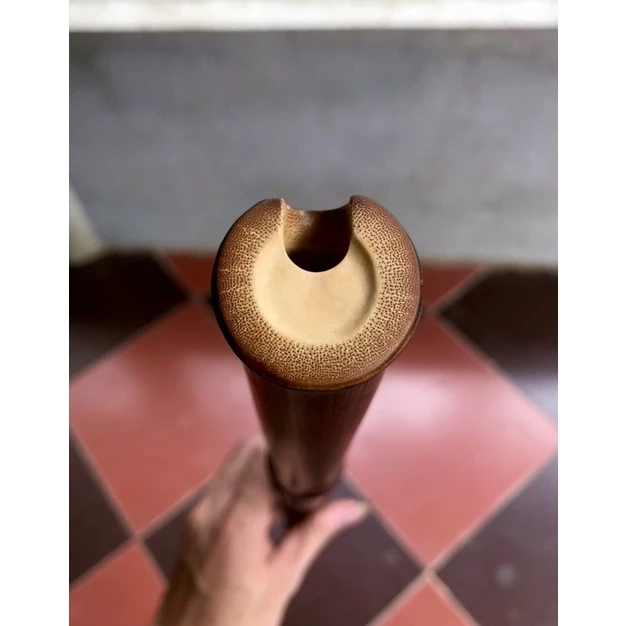
- For the Bamboo Vertical Flute the end is cut horizontally with a semi-circular hole carved into the edge. The player places their lower lip on the horizontal cut to blow air into the edge hole.
2. Sound:
- The Bamboo Vertical Flute produces a deep, warm sound, not as naturally resonant as the flute. However, when it resonates, the sound is magical.
- The blowing end of the Bamboo Vertical Flute has a U or V shape, or a combination of both, and the player rests their chin to blow.
- The blowing end of the vertical flute is more complex, with one end to hold in the mouth and a hole just below it where the air meets the lower edge (sharp air), creating a pressure difference that vibrates the air column inside the flute, producing sound.
- Both the Bamboo Horizontal Flute and the Bamboo Vertical Flute work on the same principle, but the Bamboo Vertical Flute and horizontal flutes allow for angle adjustments of the airflow, whereas vertical flutes do not (as they are held in one fixed position).
3. Ease of Playing:
- Transitioning from playing the flute to the Bamboo Vertical Flute is easier if you are already skilled at playing the flute. The Bamboo Vertical Flute has a deep, melancholic sound, ideal for somber melodies.
- The flute produces bright, chirping, and lively sounds (like the high G flute played by Dinh Thin on the road to victory or Tien Vuong's free bird).
Common Features:
- Melancholic pieces often use the Bamboo Vertical Flute while cheerful, fast-paced music uses the flute. Sometimes, both instruments are played together in an ensemble.
- Although playing the Bamboo Vertical Flute or Bamboo Horizontal Flute solo is beautiful, it can feel monotonous as they are monophonic instruments.
- Both instruments have the capability to harmonize with other musical instruments.
Share