Vietcraft.art
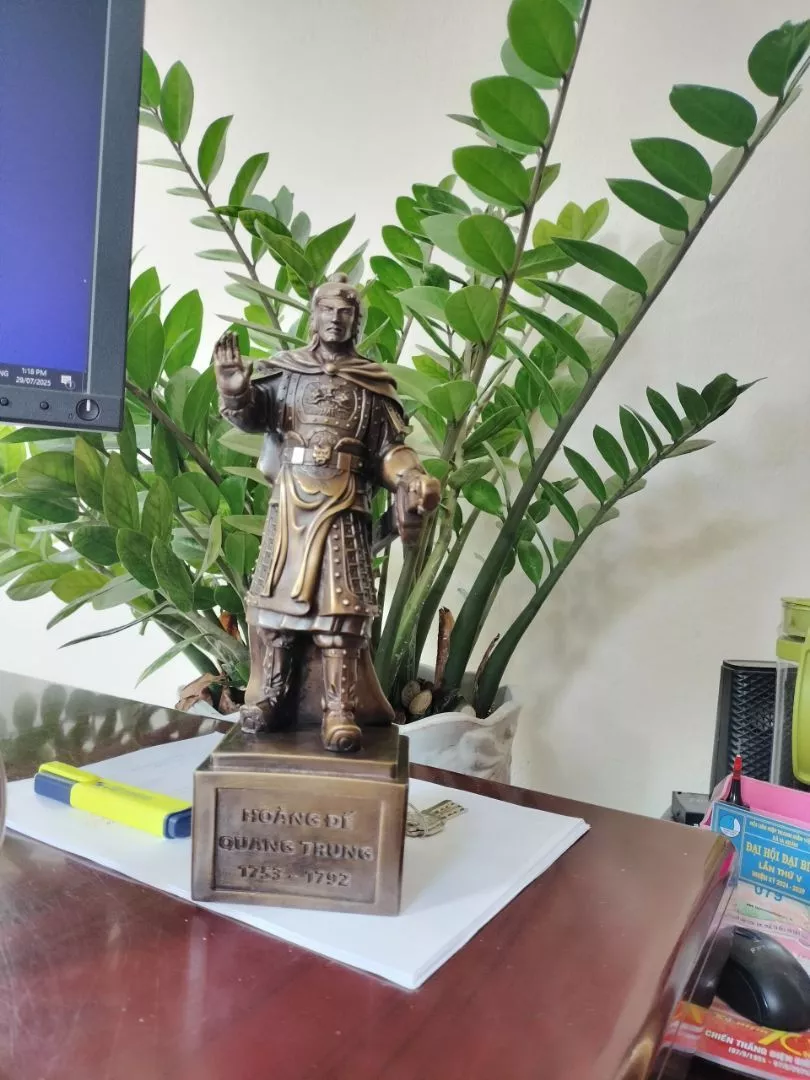
Emperor Quang Trung (Nguyen Hue) Bronze Statue – Vietnamese Heritage
Emperor Quang Trung (Nguyen Hue) Bronze Statue – Vietnamese Heritage
Couldn't load pickup availability
1. MEET YOUR QUANG TRUNG STATUE – A HAND-CAST VIETNAMESE HERITAGE SCULPTURE
Bring a meaningful connection to Vietnamese history into your space with this bronze statue of Emperor Quang Trung, also known as Nguyen Hue. Hand-cast in Vietnam, this 30 cm sculpture is suited to a study, office, or collection of Vietnamese historical figures.
Product Details
- Subject: Emperor Quang Trung – Nguyen Hue
- Material: Yellow bronze
- Construction: Hollow-cast
- Craftsmanship: Hand-cast
- Finish: Antique brown or antique gold patina
- Dimensions: 30 cm high × 9 cm wide × 9 cm deep
- Origin: Vietnam
Who It’s For
A thoughtful choice for collectors of Vietnamese historical sculpture, admirers of Vietnamese culture, or anyone seeking a commemorative gift with a connection to the country’s heritage.
Handmade & Finish Notice
Subtle differences in casting detail and patina may occur between hand-cast pieces. The listing describes antique brown and antique gold finishes. If you prefer a particular finish, please confirm availability before ordering.
Care
Dust gently with a soft, dry cloth. Avoid abrasive polishing, harsh chemicals, and prolonged exposure to moisture to help preserve the surface finish.
Shipping & Import Charges
Import duties and import taxes covered by Vietcraft.art.
We ship from Vietnam and cover import duties and import taxes for all shipping options listed below, including express shipping and heavy or bulky items. Shipping fees are separate from the product price.
For small, lightweight items, our preferred shipping services are USPS for deliveries to the United States, and Royal Mail or YunExpress for deliveries to the European Union. Heavy or bulky items shipped to the United States or European Union must use express shipping services such as UPS, FedEx or DHL. Items exceeding ePackage size limits must also use express shipping.
Standard Shipping to the United States
- Carrier: USPS
- Estimated delivery: 14–28 days
- Import duties and import taxes: Covered by Vietcraft.art
Standard Shipping to the European Union
- Carrier: Royal Mail or YunExpress
- Estimated delivery: 16–30 days
- Import duties and import taxes: Covered by Vietcraft.art
Express Shipping to the United States & European Union
- Carrier: UPS, FedEx or DHL
- Estimated delivery: 10–18 days
- Import duties and import taxes: Covered by Vietcraft.art
Please Note
Available shipping methods depend on your destination and the packed parcel’s weight and dimensions. Standard shipping is not available for heavy, bulky or oversized items. Delivery times are estimates, not guaranteed arrival dates, and may vary due to customs processing and local delivery conditions.
2. THE STORY BEHIND YOUR QUANG TRUNG STATUE – THE LEGACY OF NGUYEN HUE
Detailed Feng Shui Meaning of the Quang Trung Bronze Statue
Enhancing Intelligence and Decisiveness: With legendary military strategy and brilliant tactical thinking, the Quang Trung statue brings energy that supports leaders and entrepreneurs in becoming insightful, wise, and effective in problem solving.
Protection and Energy Stabilization: Bronze belongs to the Metal element in traditional feng shui; the image of a powerful emperor is believed to block harmful energy, neutralize hostile influences, dispel negative forces, and create a secure and stable working environment.
Career Advancement: As a symbol of the undefeated cloth-robed hero, the statue promotes smooth career development, helps overcome challenges, and strengthens prestige and authority.
National Spirit and Gratitude: Representing the moral principle of “remembering the source when drinking water,” worshipping the Quang Trung statue nurtures national pride, spiritual faith, and harmony within the family.
Placement and Display Notes for the Quang Trung Bronze Statue
- Best placement: office, working desk, living room, traditional room, or institutional space.
- Orientation: should face the main entrance or an open, elevated direction; avoid placing directly on the floor.
- Respectful placement: avoid private areas such as bedrooms or bathrooms.
Biography of Quang Trung and the Unfinished Dream of Expanding the Nation
King Quang Trung stands proudly before the battlefield
The imperial golden robe radiates majestic authority
The sacred sword of the Southern Heaven is firmly worn
Upon the war elephant’s head, heroic spirit rides like a soaring dragon.
King Quang Trung was a talented ruler and a heroic cloth-robed champion of the nation. A general undefeated in battlefields who brought freedom to the people, helping them rise against invasions from Siam, the historical name of Thailand, and the Manchu-led Qing dynasty of China.
His contributions are countless and remain brilliant milestones throughout the heroic history of the Vietnamese nation. The following biography helps readers better understand Emperor Quang Trung — a brilliant ruler filled with ambition to unify the country and bring peace and independence to the people.
Biography of the Cloth-Robed Hero Quang Trung
According to Vietnamese historical works such as Dai Nam thuc luc (the Veritable Records of Dai Nam) and Viet Nam su luoc (a concise history of Vietnam), King Quang Trung (also known as Nguyen Hue) was the son of Ho Phi Phuc, born in Tay Son village, Phu Ly district of Quy Nhon prefecture (present-day Binh Dinh province in central Vietnam).
Quang Trung was born in 1753 during the reign of King Le Hien Tong, a ruler of Vietnam’s Le dynasty. Besides the name Nguyen Hue, he was also known as Quang Binh, Van Hue, and Ho Thom.
In the book Quang Trung anh hung dan toc (Quang Trung, National Hero), he was described as having curly hair, rough skin, lightning-like eyes, a resonant voice like a bell, agility, strength, and courage. His eyes were said to shine brightly even without lamps.
He studied literature and martial arts under teacher Truong Van Hien together with his brothers Nguyen Nhac and Nguyen Lu. All three became masters of martial arts and founders of several techniques within the Tay Son Binh Dinh martial tradition. The people honored them as the Tay Son tam kiet, meaning the three outstanding figures of Tay Son, playing a major role in the development of the Tay Son movement.
It was teacher Truong Van Hien who recognized Nguyen Hue’s extraordinary talent and encouraged the brothers to rise in rebellion and build a great future enterprise. The prophetic saying “Tay khoi nghia, Bac thu cong” was attributed to him.
The Uprising Ending the Division Between Dang Trong and Dang Ngoai
Vietnam had been divided between the Le-Trinh rulers in the North and the Nguyen lords in the South, separated by the Gianh River. These northern and southern territories were known as Dang Ngoai and Dang Trong respectively. One nation suffered under three layers of authority, causing severe hardship for the population.
The corruption and arrogance of Truong Phuc Loan, an official in the Nguyen lords’ administration, intensified public resentment.
Uprising Against the Nguyen Lords
In 1771, Nguyen Nhac, Nguyen Hue, and Nguyen Lu launched the Tay Son uprising. Nguyen Hue assisted in economic consolidation and military training, quickly building a powerful army supported by many notable commanders such as Nguyen Thung, Bui Thi Xuan, Vo Van Dung, Tran Quang Dieu, Truong My Ngoc, Vo Xuan Hoai, and Vo Dinh Tu.
Despite being a peasant uprising, the Tay Son rebellion became the only peasant revolt to achieve complete victory.
By December 1773, Tay Son forces defeated the Nguyen army under its commander Ton That Huong and gained control over much of the South Central region.
Facing attacks from both Nguyen and Trinh forces, Nguyen Nhac temporarily submitted to the Trinh lord to preserve strength. Nguyen Hue later defeated invading forces in Quang Nam, a region in central Vietnam, and achieved major victories, eliminating Nguyen power within seven months.
Nguyen Nhac crowned himself emperor in 1778, while Nguyen Anh, a rival leader of the Nguyen side, rose with support from France and Portugal but was forced to flee to Siam.
In January 1785, Nguyen Hue annihilated approximately 20,000 Siamese troops at the battle of Rach Gam – Xoai Mut, terrifying regional powers with the strength of the Tay Son army.
Campaign Against the Trinh Lords
After securing Dang Trong, Tay Son forces advanced north, captured Phu Xuan, the historical center associated with present-day Hue, and marched to Thang Long, the historical name of Hanoi. Trinh Khai, the Trinh lord, committed suicide after defeat.
Internal conflicts later emerged among the Tay Son brothers, allowing Nguyen Anh to regain Gia Dinh, a historical center in southern Vietnam.
Nguyen Hue returned north, suppressed opposition under Le Chieu Thong, a ruler of the Le dynasty, and confronted the Qing invasion.
In 1788, Nguyen Hue proclaimed himself emperor with the reign title Quang Trung, unifying Tay Son leadership.
The Historic Rapid Victory Over the Qing Army
On 26 December 1788, Quang Trung recruited troops in Nghe An, a province in north-central Vietnam, implementing compulsory conscription. His army quickly reached 100,000 soldiers divided into five divisions.
He promised to defeat the Qing army and celebrate Tet, the Vietnamese Lunar New Year, in Thang Long.
With extraordinary speed, his forces marched from Thanh Hoa to Ninh Binh, two regions south of Thang Long, in one day. Launching coordinated surprise attacks, Tay Son forces destroyed Qing defenses. General Sam Nghi Dong, a commander on the Qing side, committed suicide, and Qing commander Ton Si Nghi fled across the border.
Within six days, earlier than planned, Quang Trung fulfilled his promise and entered Thang Long on the fifth day of Tet amid public celebration.
Post-War Governance Policies
As a ruler originating from the peasantry, Quang Trung implemented people-centered reforms:
- Valued talented individuals as the “vital energy of the nation.”
- Recruited former Le officials.
- Promoted Nom script, a historical writing system used for the Vietnamese language, instead of dependence on foreign writing systems.
- Simplified taxation and abolished unreasonable levies.
- Encouraged agriculture, labor productivity, and commercial expansion.
He aimed to build a strong commercial and industrial economy while maintaining stable diplomatic relations with China, though secretly preparing for future expansion.
The Unfinished Dream of National Unification
After stabilizing the North, Quang Trung prepared a southern campaign to unify the country against Nguyen Anh, who had gained French military support.
While planning a large campaign of 200,000–300,000 troops, Quang Trung suddenly died, leaving his national unification plan unfinished.
Mystery Surrounding the Death of Quang Trung
Historical records state that in early autumn 1792, while working, Quang Trung suddenly collapsed. He summoned Tran Quang Dieu, one of his military commanders, to discuss relocating the capital but passed away before plans were completed.
He died on 16 September 1792 at about 11–12 p.m., aged 40, after only four years on the throne.
The exact cause of death remains unknown and continues to be debated by historians.
Tomb Destruction and Rival Nguyen Anh
Ten years after his death, the Tay Son dynasty collapsed. Nguyen Anh ordered the exhumation of Nguyen Nhac and Nguyen Hue’s tombs, grinding remains into powder and imprisoning skull relics, driven by long-held vengeance.
Both Nguyen Hue and Nguyen Anh were talented leaders with unwavering determination, yet stood on opposing sides of history as irreconcilable rivals.
The Love Story with Princess Ngoc Han
Quang Trung married Princess Ngoc Han, daughter of King Le Hien Tong, initially as a political alliance. Their marriage in August 1786 evolved into a genuine partnership.
Princess Ngoc Han became both beloved wife and political collaborator in cultural and educational reforms.
After Quang Trung’s death six years later, she composed the mournful poem Ai tu van, a lament expressing profound grief.
Quang Trung’s life was short, yet his achievements shine permanently in Vietnamese history. He is honored as one of the fourteen outstanding national heroes — the cloth-robed hero forever remembered by history.
Quang Trung’s Preparation to Reclaim Territory from the Qing Dynasty
According to Nguy Tay liet truyen, a historical account concerning the Tay Son, after expelling Qing forces and restoring diplomatic relations with Emperor Can Long, the Qing emperor, Quang Trung repeatedly asserted territorial claims toward the Qing court.
He demonstrated military strength through victories over internal rebellions and border campaigns. Historical accounts describe successful campaigns capturing enemy leaders and extending operations to the Siam border.
Quang Trung sought to recover territories previously annexed by Qing authorities and requested boundary clarification from the Liangguang governor, whose jurisdiction concerned Guangdong and Guangxi in southern China.
After rejection, he secretly prepared naval forces and military expansion plans toward Guangdong and Guangxi.
He reportedly stated to his generals that with several more years strengthening military power, there would be nothing to fear.
Strategically, he also accepted anti-Qing groups such as pirate and resistance factions, using them to weaken Qing maritime security.
His ambitions extended beyond lost territories, aiming to reclaim Guangdong and Guangxi — regions once belonging to Nam Viet during the era of Trieu Da, a ruler associated with that ancient kingdom.
The proposal to marry a Qing princess was viewed as an opening move in this ambitious geopolitical strategy. Some historical sources suggest Emperor Can Long even considered granting Guangxi as part of a dowry arrangement, but Quang Trung’s sudden death ended the plan before it could unfold.
Share