Vietcraft.art
Double Bamboo Flute in C Tone – Traditional Hmong Style Instrument from Vietnam
Double Bamboo Flute in C Tone – Traditional Hmong Style Instrument from Vietnam
Couldn't load pickup availability
1. MEET YOUR SAO MEO – A HANDMADE DOUBLE FLUTE FROM VIETNAM
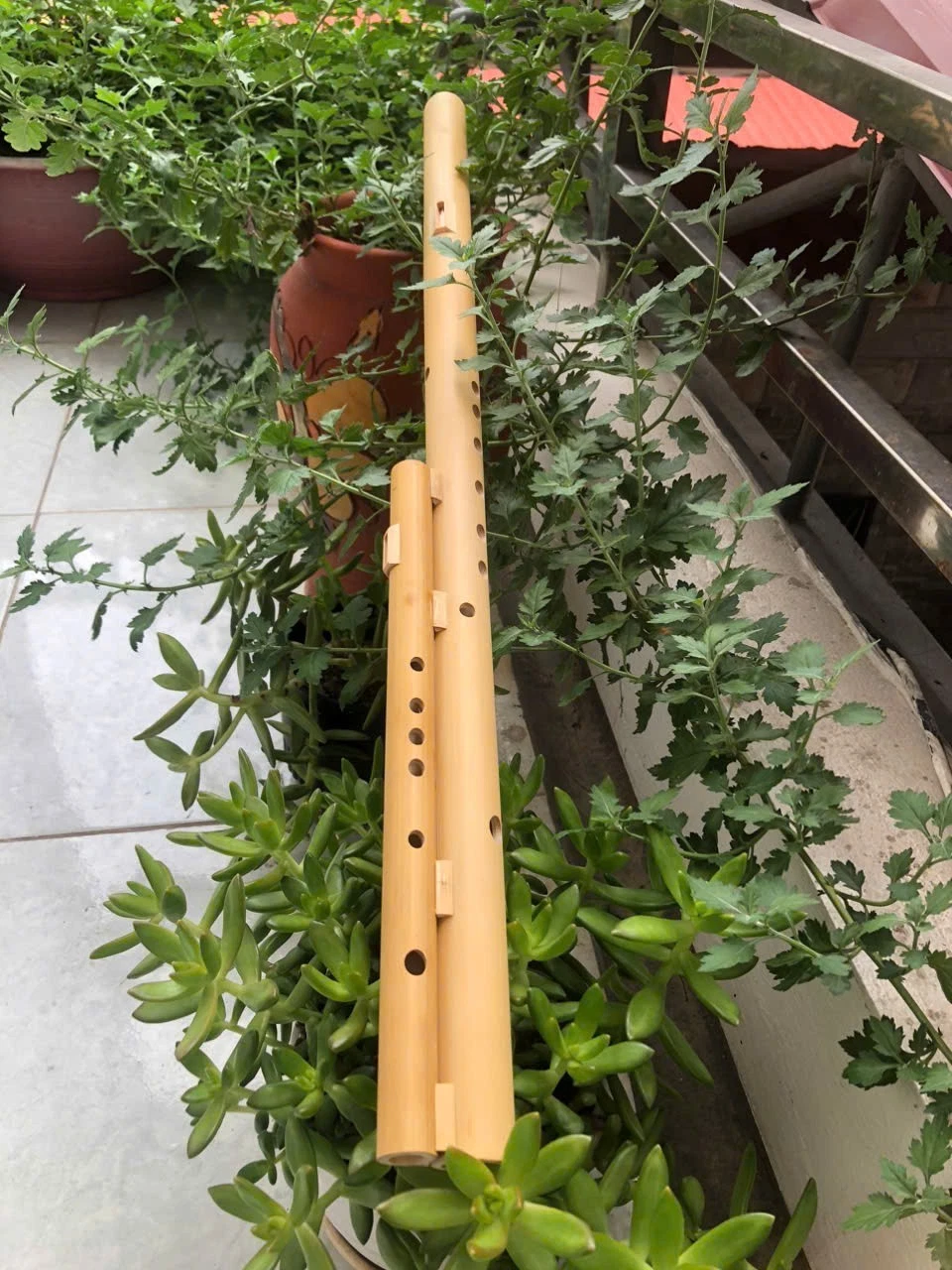
Discover the distinctive voice of Vietnam’s northern mountains with this handmade Sao Meo double flute in C tone. Crafted from natural bamboo, this traditional Hmong-style instrument brings together two pipes with contrasting lower and higher voices.
Product Details
Instrument: Sao Meo kép, a Vietnamese Hmong-style double flute.
Key: C / Do.
Construction: Two bamboo pipes, one lower-pitched and one higher-pitched.
Material: Natural bamboo with an untreated finish.
Fingering: Vietnamese 8-hole system on the lower pipe.
Sound mechanism: A metal free reed that vibrates with the player’s breath.
Origin: Handmade in Vietnam.
Who It’s For
A distinctive instrument for traditional and world-music enthusiasts, musicians exploring free-reed sounds, and collectors interested in Vietnamese musical heritage. Take your time getting to know its voice: producing a steady tone requires practice with breath control and fingering.
Handmade & Natural Material Notice
Every piece of bamboo has its own character. Color, grain, bamboo nodes and surface texture may vary, so the flute you receive may look slightly different from the photographs. These natural variations are part of its handmade identity.
Care
After playing, allow your flute to dry in a ventilated place. Avoid prolonged moisture, direct intense sunlight and sudden changes in temperature or humidity. Handle the reed gently.
Shipping & Import Charges
IMPORT DUTIES & IMPORT TAXES COVERED BY VIETCRAFT.ART
We ship from Vietnam and cover import duties and import taxes for all shipping options listed below, including express shipping and large-item shipments. Shipping fees are separate.
Standard Shipping to the United States
Carrier: USPS.
Estimated delivery: 14–28 days.
Import duties & import taxes: covered by Vietcraft.art.
Standard Shipping to the European Union
Carrier: Royal Mail or YunExpress.
Estimated delivery: 16–30 days.
Import duties & import taxes: covered by Vietcraft.art.
Express Shipping to the United States & European Union
Carrier: UPS, FedEx or DHL.
Estimated delivery: 10–18 days.
Import duties & import taxes: covered by Vietcraft.art.
Large Items
Products that exceed ePackage size limits must be shipped via UPS, FedEx or DHL. Standard shipping is not available for these items. We also cover import duties and import taxes for these shipments.
Please Note
Available shipping methods depend on your destination and parcel size. Delivery times are estimates, not guaranteed arrival dates, and may vary due to customs processing and local delivery conditions.
2. THE STORY BEHIND YOUR SAO MEO – HMONG CULTURE AND THE VOICE OF VIETNAM’S MOUNTAINS.
Air-Dried Natural Bamboo • Untreated Finish • Vietnamese 8-Hole System • C Tone • Handmade in Vietnam
QUICK REFERENCE – VIETNAMESE SAO MEO HMONG DOUBLE FLUTE
- Origin: Vietnam
- Cultural association: H’Mong communities of northern Vietnam
- Instrument: Sao Meo Kép (sáo Mèo kép – Vietnamese H’Mong double flute)
- Material: Natural bamboo
- Treatment: Air-dried / untreated natural finish
- System: Vietnamese 8-hole system on the male/lower flute
- Key: C / Do (Đô – C)
- Construction: Handmade in Vietnam
- Reed: Brass / metal free reed
- Configuration: Lower male flute + higher female flute
- Male flute: Larger, deeper and warmer; approximately 8-hole configuration
- Female flute: Smaller, higher and brighter; commonly fewer holes
- Musical uses: Traditional music, folk music, cultural performance, learning, world music, fusion, recording and collecting
- Natural variation: Each piece of bamboo is naturally different, so color, grain, surface texture, nodes and other characteristics may vary.
-
Important: The exact appearance shown in product photographs cannot necessarily be guaranteed because this is a handmade instrument made from natural bamboo.
IN ONE SENTENCE
A Vietnamese Sao Meo H’Mong Double Flute made from naturally dried, untreated bamboo – a lightweight meeting point of natural bamboo, brass, breath and the traditional musical culture of northern Vietnam.
Key Features
- Ethnic Sound of Northern Vietnam: Experience the soulful melodies of Vietnam’s highlands with this dual-pipe flute rooted in Hmong ethnic tradition.
- Handcrafted Dual Bamboo Pipes: Two parallel bamboo tubes - one deeper and one an octave higher - give you a full, harmonized tonal range.
- Copper Reed for Expressive Performance: Fitted with a precision-cut copper reed for strong resonance and breath control.
- Golden Aged Bamboo: Crafted from sun-dried highland bamboo for durability, smooth finish, and rich sound.
- Inspired by Hmong Symbols and Spirit: Echoes of mountain festivals, handmade textiles, and traditional music culture from Northwest Vietnam.
Product Description
Vietnam Highland Heritage in Every Note
Bring a piece of Vietnam’s mountain soul into your music collection with this traditional Hmong-style double bamboo flute (Tone C) - where every note carries the spirit of the highlands and ethnic villages.
Originating from the hills of Northwest Vietnam, this double-pipe flute is deeply rooted in Hmong traditions. Used for generations to express love, longing, and daily life, it remains a cherished voice of the mountains.
Two Bamboo Pipes - One Harmonized Voice
One pipe plays deep, mellow tones (male), while the second sings an octave higher (female). Together, they create a textured soundscape perfect for both solo and layered melodies.
Copper Reed - Easy to Play, Beautifully Expressive
The copper lam (reed) is fitted at the mouthpiece and vibrates when air flows through. With minimal breath, the flute produces a clear, stable, and resonant tone.
The design allows you to:
- Control airflow with your mouth - keep air pressure steady for the reed to respond.
- Use advanced techniques like vibrato, trills, glides, and subtle ornaments.
- Switch between the two pipes for layered or alternating melodies - like a duet by one player.
Once familiar, many players find this flute easier than conventional side-blown flutes, and more expressive for traditional or emotional music.
Crafted from Vietnam’s Golden Bamboo
Each flute is made from aged, highland-grown bamboo - carefully sun-dried, hand-polished, and finished with traditional precision.
Symbols of Hmong Culture Woven In
From its structure to its tone, the flute embodies the daily rhythm of the Hmong people. It reflects the sound of village festivals, moonlit serenades, and courtship songs carried on mountain winds.
Songs and Uses
Popular melodies include:
- "Spring Comes to the Hmong Village"
- "Moonlit Night in the Highlands"
- "Mountain Romance"
Whether you’re playing folk tunes or improvising ambient music, this flute offers deep cultural connection and artistic freedom.
A meaningful gift for musicians, collectors, or anyone inspired by Asian heritage.
Before you see this instrument simply as a Vietnamese flute, there is something important you should know.
This is not a factory-made plastic instrument designed to look like bamboo.
It begins with natural bamboo, carefully selected, prepared and naturally dried before being transformed by a Vietnamese craftsman into a traditional Sao Meo double flute.
The bamboo is not covered with an artificial decorative finish.
Its natural color remains.
Its natural grain remains.
Its natural texture remains.
The material is allowed to show what it is.
And that simplicity is part of its character.
At Vietcraft.art, we believe this is one of the fascinating things about traditional Vietnamese instruments: a craftsman does not always need to hide the material behind decoration.
Sometimes, the bamboo itself is the story.
The bamboo grows.
The bamboo matures.
The bamboo is selected.
It is dried.
The craftsman shapes it.
The holes are made.
The brass reed is fitted.
And eventually, someone breathes into it.
The bamboo becomes a voice.
TWO VIETNAMESE HMONG DOUBLE FLUTES – WHAT IS THE DIFFERENCE?
At first glance, this flute may look very similar to our smoke-treated natural bamboo-root Sao Meo double flute.
But they begin with two different material stories.
1. Smoked Bamboo Root Double Flute
The other version begins from a natural aged bamboo root and is traditionally smoke-treated. Its root structure, darker color and irregular natural form give it a rugged and distinctive appearance.
Its character is associated with a warmer, fuller and more earthy visual and playing experience.
2. Untreated Natural Bamboo Double Flute
This version begins with a natural bamboo tube, carefully dried and left untreated.
There is no smoke-treated finish.
The bamboo keeps a lighter and more natural appearance, allowing its original color and grain to remain visible.
It is generally lighter in the hands and offers a simpler, cleaner interpretation of the traditional Sao Meo.
Its character can feel bright, light and more open, making it particularly appealing to players who enjoy the natural beauty of untreated bamboo.
QUICK COMPARISON
| Feature | Smoked Bamboo Root | Untreated Natural Bamboo |
|---|---|---|
| Material | Natural aged bamboo root | Natural bamboo tube |
| Treatment | Traditional smoke treatment | Air-dried / untreated |
| Appearance | Darker, rustic, distinctive root structure | Lighter, natural bamboo appearance |
| Feel | More solid and substantial | Lighter and easier to handle |
| Sound character | Warm, earthy, fuller | Bright, light, more open |
| Material individuality | Every root has its own shape | Natural bamboo grain and color remain visible |
| Best for | Players and collectors who love rugged natural character | Players who prefer simple, lightweight natural bamboo |
TWO FLUTES. TWO PERSONALITIES.
One carries the rugged character of a smoke-treated bamboo root.
The other preserves the simple beauty of natural, untreated bamboo.
Neither is simply “better.”
They offer two different ways to experience the traditional voice of Vietnam's mountain music.
IMPORTANT PRODUCT INFORMATION BEFORE YOU BUY
- Product name: Vietnamese Sao Meo Hmong Double Flute – Natural Untreated Bamboo
- Vietnamese name: Sao Meo Kép Nứa Mộc (sáo Mèo kép nứa mộc – Vietnamese H’Mong double flute made from natural untreated bamboo)
- English name: Vietnamese Sao Meo Hmong Double Flute
- Origin: Vietnam
- Material: Natural bamboo
- Treatment: Air-dried / untreated natural finish
- Instrument type: Double Sao Meo / H’Mong flute
- System: Vietnamese 8-hole system
- Key: C / Do (Đô – C)
- Construction: Handmade in Vietnam
- Reed: Brass reed / metal free reed
- Configuration: Lower male flute + higher female flute
- Intended uses: Learning, practice, performance, traditional Vietnamese music research, collecting, cultural exploration, world music, fusion music and recording.
Because this instrument is made from natural bamboo, the exact color, grain, surface texture and small natural characteristics may vary slightly from one instrument to another.
The bamboo is a natural material rather than a perfectly uniform industrial tube.
These differences are part of the character of natural bamboo and handmade craftsmanship.
WHAT MAKES THIS SAO MEO DOUBLE FLUTE DIFFERENT?
There are many bamboo flutes in the world.
There are also many traditional flutes in Vietnam.
But this instrument has a distinctive voice.
It is a Sao Meo Kép, a Vietnamese H’Mong double flute associated with the musical traditions of northern Vietnam.
And its story begins with something remarkably simple:
bamboo.
1. THE BAMBOO – WHERE THE STORY BEGINS
The first thing you may notice about this instrument is its natural material.
Unlike plastic or factory-made synthetic instruments, bamboo begins as a living plant.
Its structure is created by nature before a craftsman ever touches it.
The bamboo can have differences in:
- color
- diameter
- wall thickness
- nodes
- grain
- texture
- natural markings
- proportions
These details are not added afterward.
They are part of the original material.
The craftsman works with the bamboo rather than trying to make every piece look completely identical.
That is why a handmade bamboo instrument has a different feeling from an industrial product.
You are not simply holding a manufactured tube.
You are holding a piece of natural material that once grew in Vietnam.
And then a craftsman gives that material a voice.
2. WHY THE NATURAL BAMBOO MAY LOOK DIFFERENT FROM THE PHOTO
This point is important for international buyers.
When a customer in Europe, North America or Australia sees a product photograph, it is natural to expect the instrument received to look exactly the same.
With a natural bamboo instrument, that expectation needs to be adjusted slightly.
The instrument you receive may differ from the photograph in:
- bamboo color
- grain pattern
- surface texture
- node appearance
- small natural marks
- subtle proportions
These are not necessarily defects.
They are simply characteristics of natural bamboo.
If you are looking for a product where every piece has exactly the same color, texture and appearance, this is not that type of product.
If you appreciate natural materials and handmade craftsmanship, these small differences are part of the attraction.
3. NATURAL AIR-DRYING – WHEN BAMBOO IS ALLOWED TO BECOME A MUSICAL MATERIAL
This version is made from natural bamboo that is dried before being turned into the instrument.
The purpose is not to create a dark decorative surface.
Instead, the goal is to prepare the bamboo as a workable natural material while preserving its original appearance.
There is no smoke-treated finish covering the bamboo.
There is no need to make every piece look artificially identical.
The result is a flute that retains the visual simplicity of natural bamboo.
You can still see the material.
You can still see its grain.
You can still see its natural color.
The bamboo remains visually connected to the plant from which it came.
4. WHAT IS SAO MEO?
Sao Meo is a traditional free-reed wind instrument closely associated with H’Mong musical culture in the mountainous regions of northern Vietnam.
It is also commonly referred to as Sao Mong (sáo Mông – H’Mong flute).
Unlike a conventional Western flute, Sao Meo uses a free reed to create its characteristic sound.
Its voice can be:
- deep
- resonant
- strong
- rustic
- warm
- emotional
- plaintive
- expressive
- sometimes almost voice-like
The brass reed is one of the most important reasons for this distinctive character.
When the player blows into the instrument, the airflow causes the metal reed to vibrate.
The vibration excites the air column inside the bamboo body.
Breath becomes vibration.
Vibration becomes sound.
And sound becomes music.
5. THE BRASS REED – THE HEART OF SAO MEO
If the bamboo body is the body of the instrument, the brass reed can be thought of as one of its most important musical organs.
This small piece of metal has an enormous influence on the instrument's ability to speak.
When air passes around the reed, the reed vibrates rapidly.
The vibration interrupts the airflow and excites the air column inside the bamboo.
In simplified form:
Breath → Reed vibration → Pulsed airflow → Bamboo resonance → Sound
The finger holes then allow the player to change the effective length of the air column.
Different air-column lengths create different pitches.
This means that the character of Sao Meo comes from the interaction between:
reed + air pressure + bamboo bore + finger holes + player's breath
The bamboo provides the body.
The reed provides the vibration.
The player provides the breath.
6. AN EXTRAORDINARY FEATURE – THE REED CAN RESPOND IN BOTH DIRECTIONS
One fascinating characteristic of the Sao Meo reed mechanism is that skilled players can use controlled blowing and inhaling actions as part of continuous playing.
This is very different from the basic experience of a conventional transverse flute.
For an experienced player, this can help create a more continuous musical line.
The breath does not always have to interrupt the music.
The breath itself can become part of the music.
For a beginner, this is simply one of the unusual things to discover about Sao Meo.
For an experienced player, it becomes part of the instrument's expressive vocabulary.
7. WHERE DID SAO MEO COME FROM?
Sao Meo has roots in the long-standing musical life of H’Mong communities living in the mountainous regions of northern Vietnam and neighboring areas.
Its cultural story is connected with:
- mountain life
- community gatherings
- festivals
- agricultural life
- courtship traditions
- personal expression
The instrument developed from the use of natural materials available in the mountain environment.
Bamboo could be transformed into an instrument capable of producing a strong and distinctive sound across the landscape.
Imagine:
Steep mountains.
Terraced fields.
Small villages separated by distance.
Cold evenings.
Open valleys.
In such an environment, music can travel farther than conversation.
And the sound of a flute can become a way of carrying emotion across space.
8. FROM DAILY LIFE TO MUSIC
Traditional musical instruments are not necessarily created for concert halls.
Music can appear after agricultural work.
It can accompany moments of rest.
It can appear at festivals and community gatherings.
It can be heard in villages and markets.
It can accompany quiet evenings.
In this context, an instrument is not separated from everyday life.
It belongs to the landscape.
It belongs to the people.
It belongs to the moment.
This is one reason Sao Meo can feel so different to a Western listener.
It does not simply sound like an instrument designed for a modern concert stage.
It sounds connected to a place.
9. SAO MEO AND H’MONG COURTSHIP
One of the most fascinating cultural associations of Sao Meo is its role in courtship.
Traditional stories and cultural accounts describe young H’Mong men using the flute to express feelings toward young women.
The sound could become a form of communication.
Instead of saying everything directly with words, music could express:
- longing
- affection
- loneliness
- attraction
- a desire to meet
The flute therefore became more than entertainment.
It became a voice of emotion.
The beautiful idea behind these traditions is simple:
When words are difficult, music can speak.
10. WHY THE SOUND OF SAO MEO CAN FEEL LIKE A HUMAN VOICE
The player does not simply strike the instrument.
The player breathes into it.
Breath pressure changes.
The mouth changes.
The airflow changes.
The reed responds.
The air column responds.
The fingers change the pitch.
And suddenly, the instrument begins to resemble a human voice.
Vibrato can make a sustained note feel alive.
Sliding between pitches can create a crying or yearning quality.
Half-holing can alter pitch and tone color.
Tonguing can create articulation.
Changes in breath pressure can completely change the character of a note.
This is why a skilled Sao Meo player does not simply play notes.
They shape phrases.
They breathe emotion into them.
The instrument can sound as if it is speaking.
Not through words.
Through breath.
11. WHY IS IT CALLED A DOUBLE FLUTE?
This is a Sao Meo Kép (sáo Mèo kép – Vietnamese H’Mong double flute).
Unlike a single Sao Meo, the double instrument combines two flute bodies into one playing system.
The two bodies have different sizes and registers.
One is associated with the lower male register.
The other is associated with the higher female register.
They can be understood as:
Sao Meo Nam – Male Flute
and
Sao Meo Nu – Female Flute
The lower instrument provides a deeper foundation.
The higher instrument provides a brighter register.
Together, they create a wider musical space than a single flute can easily provide.
It is not simply:
one flute + another flute.
It is a musical dialogue.
One voice answers another.
12. SAO MEO NAM – THE LOWER VOICE
The Sao Meo Nam is generally the larger and lower-register flute.
Its body is longer and its bore is larger.
It provides the deeper foundation of the double instrument.
Its sound can be:
- warm
- deep
- resonant
- strong
- grounded
- slightly rough
This lower voice gives the double Sao Meo its depth.
13. SAO MEO NU – THE HIGHER VOICE
The Sao Meo Nu is smaller and shorter.
Its bore is smaller and it produces the higher register.
Its character can be:
- clear
- high
- bright
- lively
- delicate
- expressive
If the lower flute sounds grounded, the higher flute can feel lighter and more distant.
Together, they create contrast.
14. WHY TWO FLUTES ARE NECESSARY
The double design is not simply decorative.
The free-reed construction of Sao Meo limits the practical range available from a single flute.
Instead of forcing one instrument to cover everything, traditional design brings together two complementary voices.
The lower flute carries the lower register.
The higher flute extends the musical range.
A limitation becomes an opportunity.
Two complementary voices are brought together.
15. THE C-TONE DOUBLE SAO MEO
This instrument is described as a C-tone configuration.
The male flute provides the lower C register.
The female flute continues into the higher register.
The source material for the original Sao Meo listing describes the lower flute as covering a range beginning around low Sol and continuing upward toward C2, while the higher flute extends further into the upper register.
The Sao Meo therefore does not simply behave like a Western chromatic flute.
It has its own musical grammar.
For musicians accustomed to Western instruments, this is part of what makes learning Sao Meo interesting.
16. THE VIETNAMESE 8-HOLE SYSTEM
The instrument uses the Vietnamese 8-hole system.
The holes allow the player to control pitch through combinations of finger position and airflow.
But playing Sao Meo is not simply about opening and closing holes.
The expressive possibilities include:
- breath control
- vibrato
- sliding
- ornamentation
- finger pressure
- half-holing
- tonguing
- pitch bending
- changes in airflow
- subtle embouchure changes
- movement between the male and female flute
Two musicians can play the same melody and still sound completely different.
The difference comes from breath.
Timing.
Finger movement.
Reed control.
And musical expression.
17. NATURAL BAMBOO – A DIFFERENT KIND OF BEAUTY
The untreated version has a very different visual personality from the smoke-treated bamboo-root version.
There is no dark smoky surface.
There is no dramatic root structure.
Instead, the beauty comes from simplicity.
The bamboo may appear lighter.
The natural grain remains visible.
The surface retains a more straightforward bamboo character.
The instrument feels connected to the material from which it was made.
It is less about dramatic appearance.
It is more about:
bamboo → craftsmanship → reed → breath → music
18. NATURAL BAMBOO AND SOUND
The material story can also influence how the instrument feels to the player.
The untreated natural bamboo version can feel:
- lighter
- simple
- responsive
- bright
- open
The sound character may be perceived as lighter and brighter compared with the warmer, fuller character associated with the smoke-treated bamboo-root version.
But the final sound of a Sao Meo is never determined by bamboo alone.
It also depends on:
- reed construction
- bore
- finger holes
- airflow
- embouchure
- player technique
- individual instrument construction
The material is one part of the voice.
The musician creates the rest.
19. THE DOUBLE SAO MEO AS A MUSICAL DIALOGUE
One of the most beautiful ways to understand the double Sao Meo is to think of it as a conversation.
The lower flute speaks first.
The higher flute answers.
The lower voice provides depth.
The higher voice brings brightness.
One can sound grounded and powerful.
The other can sound light and distant.
When played together, the two voices create something larger than either instrument alone.
This idea of musical dialogue is particularly meaningful when the instrument is considered in the context of traditional H’Mong culture.
Two voices.
One instrument.
One musical conversation.
20. PLAYING THE TWO FLUTES TOGETHER
For a new player, one of the first challenges is understanding how the two flute bodies interact.
They are not simply two independent flutes.
The player controls the combined instrument as one musical system.
This requires coordination between:
- both hands
- finger placement
- breath pressure
- reed response
- mouth position
- airflow
- timing
- movement between registers
With practice, the player begins to feel less like they are controlling two pieces of bamboo and more like they are playing one extended musical voice.
21. BREATH CONTROL – THE FIRST REAL LESSON
A beginner may initially think that playing Sao Meo is mainly about covering the holes.
It is not.
The first real lesson is breath.
Too little pressure and the reed may not speak properly.
Too much pressure and the sound may become harsh or unstable.
The player gradually discovers the pressure at which the reed responds naturally.
Once that happens:
The sound starts more quickly.
The notes become more stable.
The player can begin shaping phrases rather than simply trying to make sound.
The instrument starts to respond.
22. VIBRATO – MAKING A NOTE ALIVE
A perfectly straight note can sound technically correct but emotionally flat.
Vibrato changes that.
Controlled changes in breath pressure, throat movement, finger movement or combinations of these techniques can give a sustained note movement and life.
A slow vibrato can feel spacious.
A faster vibrato can create intensity.
A subtle vibrato can make a note feel almost like a human voice.
23. SLIDING BETWEEN NOTES
Instead of jumping directly from one pitch to another, the player can gradually move between them.
The pitch bends.
The listener hears the movement itself.
This can create an expressive quality that feels:
- longing
- emotional
- melancholic
- playful
- human
For a Western musician accustomed to fixed pitches, this may initially sound unusual.
But this expressive movement is an important part of the character of traditional free-reed instruments.
24. HALF-HOLING
Half-holing is another technique that expands the expressive possibilities of Sao Meo.
Instead of completely opening or closing a hole, the player partially covers it.
This changes the effective length of the air column.
The pitch can move between standard finger positions.
It can also create subtle pitch inflections and ornamentation.
Half-holing requires sensitive finger control.
25. TONGUING – T AND K
Players can use the tongue to interrupt airflow and create rhythmic attacks.
Common syllables used when thinking about articulation include:
T – a sharper forward attack.
K – a deeper or further-back articulation.
Alternating them can create:
T-K-T-K-T-K
This becomes useful when playing faster phrases.
The tongue works together with breath, reed and airflow.
26. CIRCULAR BREATHING
One advanced technique associated with continuous wind playing is circular breathing.
The basic concept is simple to describe but difficult to master.
The player stores a small amount of air in the mouth while inhaling through the nose.
The stored air continues feeding the instrument for a short moment.
This creates the impression that the sound does not stop.
However, circular breathing is not necessary for a beginner.
First learn:
sound → fingering → breath control → phrasing
Then explore advanced breathing techniques.
27. PLAYING WESTERN MELODIES ON SAO MEO
Can you play Western songs on this instrument?
Yes, but not every melody can be played directly without adaptation.
The reason is the pitch system.
A Western melody may contain notes that are not naturally available through the Sao Meo fingering system.
The player can transpose or adapt the melody.
This is actually a valuable musical exercise.
It teaches the player to understand what the instrument naturally wants to say.
28. SAO MEO AND MODERN MUSIC
Although Sao Meo is strongly connected with traditional H’Mong culture, its possibilities do not end there.
It can be explored in:
- traditional music
- folk music
- world music
- ambient music
- experimental music
- film music
- sound design
- fusion music
- acoustic arrangements
- cultural recordings
Its distinctive voice can immediately add a sense of place to a modern recording.
A single Sao Meo phrase can suggest mountains, distance, wind, villages and open landscapes.
29. THE NATURAL BAMBOO EXPERIENCE
When you hold the untreated version, the first impression can be very different from an industrial flute.
The bamboo feels organic.
The color is natural.
The grain remains visible.
The instrument is generally lighter in the hands.
There is no attempt to make the material look artificially old or dramatically dark.
The beauty is in its simplicity.
You are holding bamboo.
And bamboo is allowed to look like bamboo.
30. WHY THE CRAFTSMAN'S JOB IS MORE THAN MAKING HOLES
From the outside, making a bamboo flute may appear simple.
Cut bamboo.
Make holes.
Add a reed.
Finished.
In reality, the process requires judgment.
The craftsman must work with:
- bamboo selection
- maturity
- wall thickness
- internal diameter
- node structure
- drying
- hole positioning
- reed construction
- reed adjustment
- pitch relationships
- response
- tone
A few millimeters can matter.
A small change in the reed can matter.
A slightly different bore can matter.
Traditional instrument making is therefore a craft rather than simply a manufacturing process.
31. WHEN THE INSTRUMENT MEETS A MUSICIAN
The craftsman's work ends when the instrument reaches the player.
Then another stage begins.
The musician must learn the instrument.
The player discovers its strengths.
They discover which notes respond most easily.
They discover how much breath produces the best tone.
They discover how the reed behaves.
They discover how far they can bend a note.
They discover where their fingers feel comfortable.
After enough practice, the instrument begins to feel like an extension of the body.
32. FOR BEGINNERS – DO NOT EXPECT PERFECTION ON DAY ONE
If you are completely new to free-reed instruments, your first attempts may sound very different from what you expected.
That is normal.
You may produce:
- unstable notes
- unexpected squeaks
- weak sounds
- rough sounds
- air noise
- notes that start late
Do not immediately assume that the instrument is defective.
The reed is responding to your breath.
Your breath control is developing.
Your fingers are learning the holes.
Your mouth is learning the correct position.
Give the instrument time.
33. FOR EXPERIENCED FLUTE PLAYERS
An experienced Western flute player may have an advantage in breath control and musical phrasing.
But some familiar habits may need to change.
The reed changes everything.
You cannot approach Sao Meo exactly like a Western concert flute.
You need to listen to the reed.
You need to understand its resistance.
You need to discover its preferred airflow.
You need to become comfortable with its different pitch system.
In other words:
Bring your musical experience, but leave some of your assumptions behind.
34. REED CARE
The brass reed is delicate and sensitive.
Moisture, saliva and dust can affect its response.
After playing, pay attention to whether:
- the reed responds immediately
- the instrument feels blocked
- moisture has accumulated
- the sound has become unusually buzzy
- the response has changed
Do not treat the reed like a rigid metal part.
It is a flexible acoustic component.
If adjustment is necessary, it should be done extremely gently.
Small adjustment → test → listen → adjust again.
Never force the reed.
35. STORAGE AND CARE
Bamboo is a natural material.
It responds to its environment.
Humidity, temperature and storage conditions can influence how bamboo behaves.
After playing:
- allow the instrument to breathe
- keep it in a dry, ventilated location
- avoid sealing it while still wet
- do not leave standing moisture inside
- keep the reed area clean
Avoid placing the instrument immediately next to:
- radiators
- heaters
- wood stoves
- strong air-conditioning vents
- direct intense sunlight
- very humid enclosed areas
Natural bamboo does not need a laboratory environment.
It simply needs sensible care.
36. WHY THIS MATTERS FOR INTERNATIONAL BUYERS
An instrument made and stored in Vietnam may eventually travel to:
- the United States
- Canada
- Europe
- the United Kingdom
- Australia
- Japan
- other climates around the world
Bamboo interacts with its environment.
Allow the instrument to acclimatize naturally after arrival.
Avoid sudden extreme changes in temperature and humidity.
This is especially important because this version deliberately preserves the natural, untreated character of the bamboo.
37. WHO IS THIS INSTRUMENT FOR?
Traditional music enthusiasts
For people interested in Vietnamese, H’Mong or Southeast Asian traditional music, the instrument offers a direct physical connection to a distinctive musical tradition.
Flute players
Western flute, recorder, whistle and other wind-instrument players may enjoy learning a completely different free-reed system.
World-music musicians
Players creating folk, world, fusion or experimental music may find the Sao Meo voice particularly useful.
Collectors
The natural bamboo construction and handmade character make each instrument visually individual.
Cultural researchers
The instrument can be interesting for people studying Vietnamese traditional instruments, H’Mong culture and Southeast Asian music.
People who simply love unusual instruments
You do not need to be a professional musician.
Sometimes curiosity is enough.
You see an instrument you have never seen before.
You hear a sound you have never heard before.
And you want to discover where that sound comes from.
38. A CULTURAL GIFT FROM VIETNAM
A traditional instrument can be a much more meaningful cultural gift than an ordinary souvenir.
It carries:
- material culture
- craftsmanship
- music
- regional identity
- human creativity
- cultural history
The recipient can hold it.
Study it.
Listen to it.
Learn about it.
And perhaps eventually learn to play it.
That creates a much deeper relationship with the culture behind the object.
39. THIS IS NOT JUST “A VIETNAMESE FLUTE”
Calling this instrument simply “a Vietnamese flute” is technically convenient but culturally incomplete.
It carries a specific musical identity.
It is connected to Sao Meo.
It is associated with H’Mong musical culture.
It reflects the mountain environment of northern Vietnam.
It uses natural bamboo.
It incorporates a distinctive free-reed mechanism.
And in its double form, it creates a dialogue between lower and higher voices.
Every one of those elements matters.
That is why at Vietcraft.art, we prefer to tell the story behind the instrument rather than presenting it as just another flute for sale.
40. FROM BAMBOO TO MUSICAL INSTRUMENT
Try to imagine the journey of the material.
First, bamboo grows.
It spends years exposed to rain, sunlight, wind and seasonal changes.
The plant matures.
The bamboo is selected.
The craftsman studies the material.
It is prepared and naturally dried.
The body is shaped.
The holes are made.
The reed is fitted.
The instrument is tested.
And finally, someone places it against their mouth and breathes.
At that moment, something remarkable happens.
The bamboo stops being merely bamboo.
It becomes a voice.
41. FROM BAMBOO TO VOICE
This is perhaps the simplest way to understand the instrument.
Bamboo → Drying → Craftsmanship → Reed → Breath → Sound → Music → Memory
The bamboo provides the material.
The craftsman provides knowledge.
The reed provides vibration.
The player provides breath.
Music provides meaning.
And memory remains after the sound disappears.
42. THE CALL OF THE MOUNTAINS
There is a reason mountain instruments often have such powerful identities.
The landscape itself becomes part of the musical imagination.
Long distances between villages.
Valleys.
Forests.
Terraced fields.
Wind.
Cold evenings.
Open skies.
The Sao Meo voice can feel strong and expressive across such a landscape.
Its reed gives the tone its distinctive presence.
Its bamboo body provides resonance.
Its expressive techniques give the music emotional movement.
Together, these characteristics create a sound that many listeners immediately associate with the mountains of northern Vietnam.
43. THE BEAUTY OF NATURAL IMPERFECTION
Modern manufacturing teaches us to expect products to be identical.
Same dimensions.
Same color.
Same surface.
Same weight.
Traditional natural-material instruments follow a different philosophy.
The material has its own personality.
The craftsman works with it.
He does not need to erase every trace of nature.
A node can remain visible.
A grain pattern can remain.
A slight color variation can remain.
A natural mark can remain.
For some people, these details are imperfections.
For others, they are precisely what makes the object beautiful.
At Vietcraft.art, we believe that a handmade instrument should be allowed to show something of its natural material.
Perfectly identical is not always the same as perfectly meaningful.
44. FOR RECORDING AND FUSION MUSICIANS
The Sao Meo can be particularly interesting for recording artists.
Its sound is immediately recognizable.
Even a short phrase can add a strong geographic and cultural identity to a recording.
It can work as:
- a lead melody
- a background texture
- an atmospheric layer
- a call-and-response voice
- an introduction
- a transition
- a cinematic sound
- a cultural accent
The sound is not perfectly sterile.
It has breath.
It has reed texture.
It has personality.
45. OWNING THE INSTRUMENT VS. UNDERSTANDING THE INSTRUMENT
There is a difference between owning a traditional instrument and understanding one.
You can buy the instrument in a few minutes.
Understanding it may take months.
You can look at photographs immediately.
Understanding why it sounds the way it does takes listening.
You can read the fingering system.
Learning to express emotion through the instrument takes practice.
This is why the story matters.
The story gives you a starting point.
The instrument gives you the physical object.
The player creates the final meaning.
46. NATURAL MATERIAL NOTICE
This product is made from natural bamboo.
Please understand that:
- color may vary
- grain may vary
- surface texture may vary
- bamboo nodes may vary
- small natural marks may be visible
- dimensions may vary slightly
- the exact appearance shown in photographs cannot necessarily be guaranteed
These variations are part of natural bamboo and handmade production.
They should not be interpreted as defects unless they affect the intended musical function of the instrument.
47. THE FINAL THOUGHT – LISTEN TO THE CALL OF THE MOUNTAINS
Imagine holding this instrument for the first time.
You see the natural bamboo.
You feel its lightness.
You notice the brass reed.
You place it against your lips.
You breathe.
At first, perhaps nothing happens.
Then the reed catches.
A vibration begins.
The bamboo resonates.
A note appears.
You try again.
The sound becomes stronger.
You move your fingers.
Another note appears.
You connect two notes.
Then three.
Eventually, a phrase begins to emerge.
And suddenly, something that began as a simple piece of natural bamboo is carrying a musical voice from Vietnam's mountains.
That is the real fascination of the Sao Meo.
It is not simply a flute.
It is not simply bamboo.
It is not simply a handmade product.
It is the meeting point of nature, craftsmanship, breath, culture and music.
From natural bamboo of Vietnam...
Through the hands of a craftsman...
Through the vibration of a brass reed...
Through the breath of a musician...
comes the call of the mountains.
THE H’MONG PEOPLE AND H’MONG FOLK SONGS IN VIETNAM
From Mountain Life, Ancient Traditions, and Bamboo Instruments to the Voice of the H’Mong People
If you want to understand H’Mong music, it is difficult to separate the music from the mountains where it was born.
The sound of a bamboo flute, the voice of a singer, the rhythm of a traditional dance, or the call of a Khen (khèn – H’Mong mouth organ) is not simply music. It is connected to the landscape, family, farming, festivals, courtship, love, separation, and the memories of generations.
For centuries, H’Mong communities have lived among the high mountains of northern Vietnam, developing a distinctive culture expressed through language, clothing, architecture, agriculture, handicrafts, oral literature, traditional festivals, and music.
Their songs can speak about love.
They can speak about waiting.
They can speak about mountains and forests.
They can comfort a child.
And sometimes, a simple melody carried by a bamboo instrument can become a message sent across a mountain valley.
THE H’MONG PEOPLE IN VIETNAM
The H’Mong (H’Mông – H’Mong ethnic group) are one of the ethnic communities living mainly in the mountainous regions of northern Vietnam.
Their traditional communities are concentrated particularly in areas at elevations of approximately 800–1,500 meters, including regions close to the borders between Vietnam and China and between Vietnam and Laos.
In Vietnam, H’Mong communities can be found across mountainous provinces stretching from Lang Son toward the north-central region, with particularly important populations in Ha Giang, Lao Cai, Lai Chau, and Son La.
During the 1980s and 1990s, some H’Mong communities also migrated southward and established settlements in parts of Gia Lai and Kon Tum in Vietnam's Central Highlands.
H’Mong communities also live across the borders of Vietnam, China, and Laos. These communities have maintained cultural connections despite living in different countries and geographic environments.
Their traditions may vary from one region to another, but many elements remain recognizable: language, clothing, farming practices, family traditions, oral literature, festivals, music, and handicrafts.
THE ORIGIN AND NAME OF THE H’MONG
The history of the H’Mong people is connected with long periods of migration across the mountains of East and Southeast Asia.
Traditional stories and historical accounts describe movements of H’Mong communities over generations, eventually leading to settlements in the mountainous regions of Vietnam, China, Laos, Thailand, and other areas.
The H’Mong have their own traditional self-name.
In different historical sources and languages, they have also been referred to by names such as Miao, Mèo, and Mẹo.
Within Vietnam, H’Mong communities are commonly distinguished by names associated with their clothing, colors, local traditions, and cultural characteristics.
These include:
-
H’Mong Trang (H’Mông Trắng – White H’Mong)
-
H’Mong Hoa (H’Mông Hoa – Flower H’Mong)
-
H’Mong Do (H’Mông Đỏ – Red H’Mong)
-
H’Mong Den (H’Mông Đen – Black H’Mong)
-
H’Mong Xanh (H’Mông Xanh – Green or Blue H’Mong)
-
Na Mieu (Na Miểu – Na Miểu H’Mong)
In some traditions, Flower H’Mong and Red H’Mong may be considered closely related or grouped together.
This diversity is important because there is no single completely uniform form of H’Mong culture.
Different communities may have different dialects, clothing patterns, ceremonies, songs, and local customs.
THE H’MONG LANGUAGE AND WRITING SYSTEM
The H’Mong language is an important part of H’Mong cultural identity.
In Vietnam, a Latin-based writing system for H’Mong was approved in 1961.
The system was largely based on the H’Mong language variety spoken in the Sa Pa–Lao Cai region.
The H’Mong language has a complex phonological structure. It has traditionally been described as having approximately 59 consonants, 28 rhymes, and 8 tones.
During the 1970s, literacy movements helped promote written H’Mong among local communities.
For the H’Mong, language is much more than a means of everyday communication.
It carries oral history, family memories, traditional knowledge, poetry, songs, stories, cultural beliefs, and knowledge of the natural environment.
Before widespread literacy, much of this cultural knowledge was transmitted orally from parents and grandparents to younger generations.
TRADITIONAL H’MONG HOUSES
Traditional H’Mong houses are adapted to the mountainous environment and to the structure of extended family life.
A traditional house commonly has three main bays and two side sections.
The central area may contain the family altar and serve as an important spiritual and ceremonial space.
Other sections can be used for cooking, sleeping, storing food, and daily household activities.
The size and construction of a house historically depended partly on the family's economic circumstances.
Livestock were traditionally kept in areas separated from the main living spaces.
The house was therefore not simply a place to sleep.
It was the center of family life, work, worship, food preparation, social interaction, and cultural transmission.
AGRICULTURE AND MOUNTAIN LIFE
Agriculture has traditionally been at the heart of H’Mong life.
H’Mong communities have cultivated:
-
Corn
-
Rice
-
Flax
-
Cotton
-
Buckwheat
-
Vegetables
-
Other mountain crops
Rice may be cultivated on mountain terraces, while corn has historically been especially important in higher areas where growing rice is more difficult.
The spectacular terraced fields of northern Vietnam are closely connected with the agricultural traditions of many highland communities.
Buckwheat is another crop strongly associated with the northern mountain landscape and has become an important cultural symbol of the region.
Historically, some H’Mong communities also cultivated opium as a commercial crop. This belongs to the history of the region rather than defining contemporary H’Mong agricultural life.
Traditional farming required physical strength and specialized knowledge of mountain terrain.
Plows and other agricultural tools were essential to preparing the land.
Livestock were also extremely important.
H’Mong families traditionally raised cattle, pigs, chickens, and especially horses.
Horses were particularly valuable in mountainous terrain because they could carry people, agricultural products, and goods along steep paths where ordinary transportation was difficult.
H’MONG HANDICRAFTS
H’Mong communities have developed a remarkable range of traditional handicrafts.
These include:
-
Bamboo and rattan basketry
-
Blacksmithing
-
Woodworking
-
Saddle making
-
Handmade paper
-
Silver jewelry
-
Agricultural tools
-
Wooden containers
-
Metal tools
-
Plowshares
-
Traditional equipment for mountain life
Traditional blacksmiths could produce practical objects needed by farming communities.
They made agricultural tools, plowshares, knives, metal parts, and other equipment.
Woodworkers produced household objects and practical containers.
Silver jewelry became an important part of traditional clothing and cultural identity.
These crafts demonstrate a practical philosophy: materials from the surrounding environment can be transformed into objects that serve everyday life while also carrying cultural meaning.
H’MONG NEW YEAR
The traditional H’Mong New Year begins during the 12th lunar month.
It generally takes place approximately one month before Tet Nguyen Dan (Tết Nguyên Đán – Vietnamese Lunar New Year).
This is one of the most important periods in the traditional H’Mong calendar.
Families gather together.
People visit relatives and friends.
Traditional clothing is worn.
Music and singing become part of community life.
Young people have opportunities to meet, communicate, sing, play instruments, and take part in traditional games and celebrations.
One important cultural tradition is Gau Tao (gầu tào – H’Mong community festival), associated with celebration, community gatherings, wishes for health and prosperity, and traditional cultural activities.
FAMILY AND SOCIAL TRADITIONS
Traditional H’Mong society has historically followed a patrilineal and patriarchal family structure.
Men traditionally played important roles in household decision-making and inheritance.
Women historically had limited rights to inherit the principal family property.
Marriage and family relationships followed established customs, and traditional clothing and silver jewelry could form part of a woman's dowry.
Like all living cultures, these traditions have changed over time.
Modern H’Mong communities participate fully in contemporary Vietnamese society while continuing to preserve many elements of their cultural heritage.
ORAL LITERATURE AND FOLK STORIES
One of the greatest treasures of H’Mong culture is its oral literature.
Before written literature became widespread, stories, legends, myths, poems, songs, family histories, and traditional knowledge were transmitted by word of mouth.
Stories could explain the origins of the world.
They could tell of cultural heroes who taught people how to grow crops.
They could describe relationships between humans and animals.
They could preserve moral lessons and memories of the past.
Among the many traditional stories are folktales involving tigers and other animals.
These stories reflect the close relationship between H’Mong communities and the natural world surrounding their mountain homes.
Oral literature and music are therefore closely connected.
A song may preserve a story.
A story may become part of a song.
And a melody may help people remember words that have been passed down for generations.
H’MONG FOLK SONGS
H’Mong folk songs are among the most expressive elements of H’Mong cultural life.
Songs can express:
-
Love
-
Longing
-
Courtship
-
Separation
-
Marriage
-
Family relationships
-
Friendship
-
Celebration
-
Sadness
-
Hope
-
Everyday mountain life
One traditional category is Gau Plenh (gầu plềnh – H’Mong love songs).
These songs are associated with love, courtship, emotional expression, and communication between young people.
Another is Gau Xuong (gầu xuống – H’Mong wedding songs), associated with weddings, marriage, and exchanges between families.
Traditional H’Mong singing can therefore function almost like a conversation.
One person sings.
Another responds.
Feelings are expressed through words and melody.
Sometimes the singer can communicate something that would be difficult to say directly in ordinary conversation.
H’MONG MUSICAL INSTRUMENTS
Traditional H’Mong music includes several distinctive instruments.
Sao
Sao (sáo – bamboo flute) is a traditional bamboo wind instrument capable of producing expressive melodies.
Its sound can be soft and intimate or strong enough to carry across a mountain valley.
Khen
Khen (khèn – H’Mong mouth organ) is one of the most recognizable traditional H’Mong instruments.
It consists of multiple bamboo pipes combined with free reeds.
Young H’Mong men have traditionally played the Khen not only as music but also while dancing.
The combination of music, movement, and social interaction makes the instrument an important part of H’Mong cultural life.
Ken La
Ken La (kèn lá – leaf instrument) is a simple but expressive instrument made using a leaf as a vibrating surface.
Its delicate sound has traditionally been associated with communication and courtship.
Dan Moi
Dan Moi (đàn môi – mouth harp) is a small instrument played near the mouth.
It produces a delicate and intimate sound and has traditionally been associated with communication between young people.
MUSIC AS A LANGUAGE OF LOVE
One of the most fascinating aspects of H’Mong traditional music is its role as a form of communication.
For young men and women, music could express feelings that were difficult to communicate directly.
A melody could become a message.
A flute could call across a mountain.
A song could express longing.
A response could become an answer.
This is why H’Mong instruments should not be understood only as musical objects.
They are also connected to relationships, emotions, courtship, community, and identity.
“XUÂN VỀ TRÊN BẢN H’MÔNG”
“Xuân về trên bản H’Mông” can be understood as “Spring Returns to the H’Mong Village.”
The image of spring arriving in an H’Mong village evokes flowers, mountains, traditional clothing, community gatherings, music, and renewal.
Spring is not simply a change of weather.
It is a cultural moment.
Families gather.
Young people meet.
Music fills the village.
Traditional clothes become visible across the mountain paths.
The landscape itself seems to become part of the celebration.
TRADITIONAL H’MONG SONGS
The following songs provide a glimpse into the emotional world of H’Mong folk music.
The original Vietnamese lyrics are preserved below, with the English translation placed immediately underneath each line.
1. DỪNG CHÂN
Dân Ca Mèo – Meo Folk Song
Xa vời rừng ban xinh tươi,
Far away, the beautiful ban forest blooms.
nở trắng ngàn đỉnh đồi,
White flowers spread across the mountain peaks.
Nắng chiều vàng non khơi, xa vời
The golden afternoon sunlight shines across the distant mountains.
Bên lửa hồng ai ngóng chờ người năm xưa,
Beside the warm fire, who is still waiting for the one from years ago?
Nàng hẹn mong anh nói nên lời, nàng yêu
She waits and hopes that he will finally speak of his love.
Anh không rời
He will not leave.
Bên lửa hồng ai đón chờ người năm xưa
Beside the warm fire, someone is waiting for the one from years ago.
Nàng còn đây bao tháng năm chờ
She is still here, waiting through so many years.
Nàng còn đây không mờ
She is still here, and her memory has not faded.
Mưa chiều, dừng chân anh ơi
In the afternoon rain, stop and rest, my love.
Kià mưa tràn đỉnh đồi
Look, the rain is pouring over the mountain ridge.
Hoa buồn vì mưa rơi, không cười
The flowers are saddened by the falling rain and no longer smile.
Bên lửa hồng nay đón chờ người năm xưa,
Beside the warm fire, she now waits to welcome the one from years ago.
Nàng hẹn mong anh nói nên lời,
She waits and hopes that he will finally speak his heart.
nàng yêu anh không rời
She loves him and will not leave him.
Bên lửa hồng nay đón người về dừng chân
Beside the warm fire, she now welcomes him home to stop and rest.
Nàng đợi qua bao tháng năm chờ,
She has waited through so many months and years.
Nàng còn đây không mờ.
She is still here, and her love has not faded.
2. TIẾNG HÁT RU CON
KHỔNG MÍ NHỦA – H’Mong Lullaby
Ơ ! Em ơi ngủ ! Em chị ngủ ngon
Oh, my little one, sleep! My little sister, sleep peacefully.
Em chị chóng ngoan đừng khóc
My little one, be a good child and do not cry.
Mẹ mua nhiều quà
Mother will buy you many gifts.
A ru hỡi mẹ mua thật nhiều xôi.
Ah, hush now, mother will buy you plenty of sticky rice.
This lullaby belongs to the intimate world of family life.
The mother's voice comforts the child while simultaneously passing language, affection, rhythm, and cultural memory from one generation to another.
3. HÁT RU CON
Mèo Vạt – Hà Giang – H’Mong Lullaby
Chim về ngàn yêu thương,
Birds return to the beloved mountains.
Con Ơi ngoan con ngũ hỡi con
My child, be good and sleep, my dear.
Ơi con ngũ ngàn lời yêu thương với đời con
Oh, my child, sleep among a thousand words of love for your life.
Chập chùng ngoài xa đêm đêm nghe tiềng rừng vọng nơi đây
Far away in the night, the sounds of the forest echo back to this place.
Ru hỡi ơi, ru hởi ru ơi.
Hush, my child, hush now, sleep peacefully.
The song reflects the quiet emotional world of the traditional H’Mong lullaby.
The surrounding mountains and forests become part of the mother's voice.
4. NHẮN GỬI
Dân ca H’Mông – H’Mong Folk Song
Nhắn Gửi đôi lời cùng anh
I send a few words to you, my dear.
Hỏi núi gọi suối bao giờ
I ask the mountains and call to the streams, wondering when...
Mừng đón anh về
I will happily welcome you home.
Nhắn gửi đôi lời cùng em
I send a few words to you, my dear.
Trông vời lưng núi
I gaze toward the distant mountain ridge.
Hẹn em chờ đến ngày anh trồng lúa
I ask you to wait until the day I plant the rice.
Trồng xong nương sắn mùa
After the cassava fields have been planted for the season.
Em đợi chờ đón anh về
You wait to welcome me home.
Nhắn gửi đôi lời cùng em
I send a few words to you, my dear.
Xa người yêu dấu anh còn đi
Far from my beloved, I must continue on my journey.
Anh dặn em đừng lo
I tell you not to worry.
Dù mưa nắng bao ngày anh về cùng em
Through many days of rain and sunshine, I will return to you.
Xa anh thì nhớ
When I am far away, remember me.
Đừng xa lòng em
Do not let your heart grow distant.
Đừng thương nhớ
Do not let longing consume you.
Nào ai ngoài
There is no one else.
Ngày trông tháng chờ
Day after day, month after month, I wait.
Một sáng anh về Vui sống cùng anh.
One morning, I will return, and we will happily live together.
“Nhắn Gửi” expresses the emotional experience of distance and waiting.
The mountains, streams, rice fields, and seasons are not merely scenery.
They become part of the language through which two people communicate their love.
5. CÔ NÓI SAO
Dân ca H’Mông – H’Mong Folk Song
Có bao giờ tôi thấy như vậy đâu!
I have never seen anything like this before!
Có ai ngờ bố mẹ cô đã nói vờ!
Who would have thought that her parents were only pretending when they spoke?
Nói cô đã đi suối
They said she had gone down to the stream.
Mà sao thấy mời những người anh em đã về đây.
Yet why do I see her inviting brothers and relatives to come here?
Có ai ngờ bố mẹ cô đã nói vờ!
Who would have thought that her parents were only pretending when they spoke?
Nói cô lấy củi trong rừng,
They said she had gone to gather firewood in the forest,
sao tôi thấy mời những người thông gia hai họ khắp nơi kéo về
yet why do I see relatives and the two families of future in-laws gathering here from everywhere?
Cô nói sao – H’Mong Phonetic Version
The following is the H’Mong phonetic version provided with the song:
Cha tang tu tang dua nê gày xinh!
What are you saying, my dear?
Cha co lềnh nả lềnh chí dúa u trù!
What could be happening here?
Háy tua dùa mông chí đề ê dúa mông
Why have so many people gathered together?
Hu lùa dơê kế dề ho.
What is the meaning of all this?
Cha cao lềnh nả lềnh chí dúa u trù
What are you saying, my dear?
Hay tua dúa mồng chi tơ na Say dúa mồng
Why have they called so many people here?
Hu lua dở ua kê trù kê lùa i tùa dua ca da
What is happening here, and why has everyone come together?
The H’Mong phonetic text is preserved as supplied. Because this is a phonetic rendering rather than a standardized H’Mong orthographic text, the English version is presented as an interpretive translation of the apparent meaning rather than as a strict word-for-word linguistic transcription.
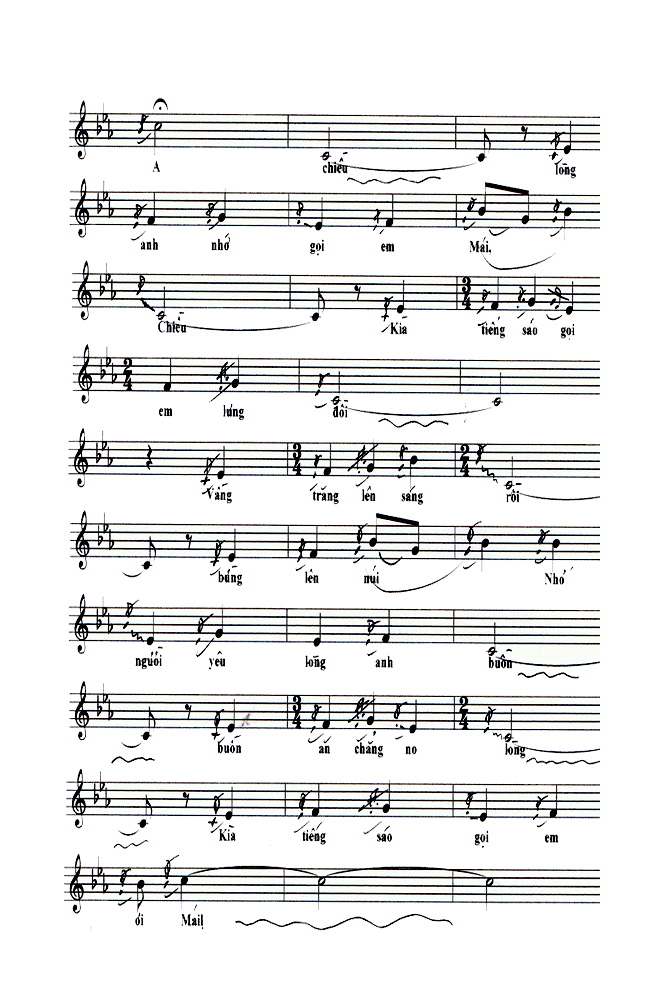
6. NHỚ EM YÊU
Dân Ca H’Mông – H’Mong Folk Song
A Chiều, lòng anh nhớ gọi em. Mái !
Ah, in the afternoon, my heart misses you and calls your name. Mai!
Chiều, kìa tiếng sáo gọi em lưng đồi.
In the afternoon, listen — the flute calls to you from the mountainside.
Vầng trăng lên sáng rồi, bừng lên núi
The moon has risen and shines brightly, lighting up the mountains.
Nhớ người yêu, lòng anh buồn
Missing my beloved, my heart becomes sad.
Buồn ăn chẳng no lòng
In sadness, even food cannot satisfy my heart.
Kìa tiếng sáo gọi em ơi Mái !
Listen, the flute is calling for you, my dear Mai!
The flute in this song becomes more than an instrument.
Its sound becomes a voice carrying longing across the mountains.
FROM BAMBOO TO MUSIC
Bamboo has always been one of the most important natural materials in the musical traditions of Vietnam's mountain communities.
A simple bamboo stalk can become a flute.
With careful selection, drying, cutting, drilling, tuning, and finishing, a piece of bamboo can be transformed into an instrument capable of carrying a human voice-like melody.
This transformation requires knowledge.
The maker must understand the material.
The player must understand breath.
And the listener must understand that behind the sound is a relationship between human beings and the natural environment.
This is one reason bamboo instruments can feel so different from modern factory-made instruments.
The material itself carries traces of the landscape from which it came.
THE SAO MEO AND THE VOICE OF THE MOUNTAINS
Among the traditional bamboo instruments associated with Vietnam's northern mountain cultures, the Sao Meo (sáo mèo – H’Mong-style bamboo flute) has a particularly distinctive sound.
The instrument uses bamboo together with a free-reed mechanism to create an expressive voice.
A double Sao Meo contains two parallel flutes.
The larger lower flute produces a deeper voice, while the smaller upper flute produces a higher voice.
Together, they can create a richer and more atmospheric sound.
For someone hearing the instrument for the first time, its voice may immediately evoke images of northern Vietnam:
mountain valleys,
misty forests,
terraced fields,
village paths,
spring flowers,
and distant calls between people living among the hills.
This emotional association is part of the fascination of the instrument.
MUSIC THAT CROSSES DISTANCE
The traditional songs presented above repeatedly return to certain themes:
Love.
Waiting.
Distance.
Mountains.
Rain.
Forests.
Family.
Home.
The voice of a flute.
These themes are not accidental.
For communities living in mountainous environments, physical distance can be part of everyday life.
A village may be separated from another village by hills and valleys.
A family member may travel far away to work.
A young man or woman may be waiting for someone to return.
Music provides a way to bridge that distance.
A song can travel farther than an ordinary speaking voice.
A flute melody can travel through a valley.
A Khen performance can gather a community.
A lullaby can travel from a mother to her child.
In this way, music becomes a form of cultural communication.
H’MONG MUSIC TODAY
H’Mong music continues to exist in both traditional and contemporary settings.
It can be heard during:
-
Traditional festivals
-
Weddings
-
Community gatherings
-
Cultural performances
-
Family celebrations
-
Courtship
-
Religious and ceremonial occasions
-
Contemporary musical performances
Younger musicians are also exploring ways to combine traditional instruments with modern musical styles.
This creates an interesting relationship between preservation and innovation.
The traditional instruments remain connected to their cultural origins, while their sounds can now reach audiences far beyond the mountains of northern Vietnam.
MORE THAN A MUSICAL INSTRUMENT
For an international listener, it may be tempting to look at a traditional bamboo flute simply as a musical instrument.
But within the cultural environment from which it comes, the story is much larger.
It is connected to bamboo.
Bamboo is connected to the landscape.
The landscape is connected to farming and village life.
Village life is connected to family and community.
Community life is connected to festivals and traditions.
And traditions are preserved through songs, stories, instruments, and generations of memory.
This is why understanding the culture behind a traditional instrument can make the instrument itself much more meaningful.
THE VOICE OF THE MOUNTAINS
The H’Mong people have preserved a remarkable cultural heritage through generations of life in the mountains of Vietnam.
Their language preserves memory.
Their handicrafts preserve practical knowledge.
Their clothing preserves identity.
Their stories preserve history.
Their festivals preserve community.
And their music preserves emotion.
A traditional song can tell someone that they are loved.
A lullaby can comfort a child.
A wedding song can connect two families.
A flute can call across a valley.
A Khen can accompany a dancer.
A simple leaf can become an instrument.
And a piece of bamboo can become a voice.
Perhaps this is the most beautiful way to understand H’Mong music.
It is not simply music created in the mountains.
It is music shaped by the mountains.
Music shaped by distance.
Music shaped by love.
Music shaped by memory.
And, above all, music shaped by people who have carried their cultural voice from one generation to the next.
For anyone discovering traditional Vietnamese instruments for the first time, the sound of the H’Mong mountains offers an invitation to listen more closely — not only to the melody, but to the story behind it.
Discover Vietnamese Traditional Musical Instruments at Vietcraft.art
At Vietcraft.art, we believe that a traditional Vietnamese musical instrument can be more than something to play.
It can be a way to hear a culture.
A way to discover craftsmanship.
A way to connect with a distant place through sound.
And perhaps, when a Vietnamese C5 bamboo flute reaches a musician somewhere in Europe, North America, or another part of the world, the journey that began in a Vietnamese bamboo forest begins again — this time through the breath of a new player.
Traditional Vietnamese Musical Instruments: A Symphony of Culture and Heritage
Welcome to our sanctuary of traditional sounds, where the rich cultural heritage and history of Vietnam are brought to life through music. Our collection of handcrafted Vietnamese traditional musical instruments is curated for musicians, cultural researchers, world music enthusiasts, and art collectors worldwide who seek authenticity and exquisite craftsmanship.
Every piece in our collection tells a story of identity, nature, community life, craftsmanship, and musical tradition across Vietnam's diverse landscapes.
From a single string that can seem to speak like a human voice to bamboo clappers that shape the rhythm of poetry, from the bright resonance of brass percussion to the deep voice of traditional drums, Vietnamese music is a conversation between many different sounds.
Explore some of the traditional Vietnamese instruments available through vietcraft.art:
-
dan nguyet (đàn nguyệt – Vietnamese Moon-Shaped Lute):
 A distinctive two-stringed Vietnamese lute with a circular body inspired by the image of the moon. Its expressive plucked sound has an important place in traditional Vietnamese music, including Chau Van, Don Ca Tai Tu, Cai Luong, and other musical traditions.
 -
dan tranh (đàn tranh – Vietnamese Zither):
 An elegant plucked zither with multiple metal strings and movable bridges. Its bright, resonant voice can produce cascading melodies, delicate ornamentation, vibrato, slides, and expressive pitch bending that give the instrument a distinctive place in Vietnamese traditional music.
 -
dan bau (đàn bầu – Vietnamese Monochord):
 Perhaps one of the most extraordinary Vietnamese traditional instruments, the Dan Bau has only one string yet can create remarkably expressive changes in pitch. Through the combination of a flexible bamboo or wooden rod, harmonic points, and delicate string manipulation, one string can bend, glide, tremble, and sing with an almost human quality. The folding Dan Bau offered by vietcraft.art also provides a practical format for storage and transportation while preserving the character of this traditional one-string instrument.
 - dan tu (đàn tứ – Vietnamese Four-String Lute): A traditional four-string Vietnamese plucked instrument offering a warm and versatile resonance. Its compact form and four-string design make it a distinctive part of Vietnam's family of traditional string instruments.
-
phach tre (phách tre – Vietnamese Bamboo Clappers):
 A traditional bamboo percussion instrument closely associated with Vietnamese traditional vocal and musical traditions, particularly Ca Tru. More than a simple timekeeper, Phach Tre can create accents, pauses, rhythmic patterns, and dynamic interactions with the singer and poetry.
 - canh (cảnh – Traditional Vietnamese Small Brass Gong): A compact brass percussion instrument producing a bright, clear, ringing, and resonant sound. Typically around 10 cm in diameter in the Vietcraft.art offering, Canh provides sharp musical accents and sonic punctuation in traditional musical, theatrical, ceremonial, and spiritual settings.
- phach tre & canh (phách tre & cảnh – Vietnamese Bamboo Clappers & Small Brass Gong): A fascinating combination of two contrasting materials and musical voices. Phach Tre contributes crisp, dry, warm rhythmic articulation, while Canh adds bright metallic resonance. Together they demonstrate how Vietnamese traditional musicians create a surprisingly rich musical palette from simple natural materials.
-
 A powerful traditional drum associated with Vietnamese theatrical and ensemble traditions. Handcrafted from solid jackfruit wood and natural buffalo hide, it provides a strong acoustic pulse and helps shape rhythm and musical atmosphere.
 - trong dan gian (trống dân gian – Vietnamese Folk Drum): Traditional Vietnamese drums carrying the vibrant rhythmic spirit of village festivals, folk performances, community gatherings, and traditional music. Natural materials such as jackfruit wood and buffalo hide contribute to their characteristic acoustic voice.
- trong ban (trống bàn – Vietnamese Traditional Drum): Another traditional percussion voice within the broader world of Vietnamese music. Traditional drums such as Trong Ban can contribute rhythm, accents, transitions, and musical atmosphere within different performance contexts.
- thanh la (thanh la – Vietnamese Metal Gong): A handcrafted brass percussion instrument producing a clear, bright, resonant tone. Its metallic voice can add emphasis and rhythmic punctuation to traditional ensembles and performances.
- song loan (song loan – Vietnamese Traditional Rhythm Percussion): A compact traditional percussion instrument associated particularly with Vietnamese Southern musical traditions such as Cai Luong. Its distinctive clicking sound can help establish rhythm and support the musical flow of an ensemble.
-
tiu & canh (tíu & cảnh – Small Gongs & Traditional Brass Percussion):
 A specialized combination of compact traditional percussion instruments producing bright, high, and distinctive metallic sounds. Their role can vary according to the musical genre, ensemble, and performance context.
 - sao truc (sáo trúc – Vietnamese Bamboo Flute): A traditional Vietnamese bamboo flute known for its clear, lyrical voice. Its sound is closely associated with the natural imagery and expressive melodic language of Vietnamese traditional music.
- tieu bat khong (tiêu bát không – Vietnamese Eight-Hole Vertical Bamboo Flute): A traditional vertical bamboo flute made from carefully selected bamboo, offering another distinctive voice within Vietnam's family of wind instruments.
-
sao meo H'Mong (sáo mèo H'Mông – H'Mông Double Bamboo Flute):
 A traditional bamboo flute associated with the H'Mông communities of Northwestern Vietnam. Its distinctive construction and sound reflect the musical culture of Vietnam's mountainous regions.
 - woodblock (mõ – Vietnamese Traditional Wooden Temple Block): Traditional wooden percussion instruments made from natural wood and used in cultural, ceremonial, religious, and spiritual settings. Their resonant wooden sound provides a distinctive rhythmic and atmospheric voice.
From One String to an Entire Musical World
The diversity of Vietnamese traditional instruments is remarkable.
Some instruments speak through strings.
Some speak through bamboo.
Some speak through brass.
Some speak through wood.
Others speak through the deep pulse of a drum.
The dan bau can create an astonishing range of expressive pitch from a single string.
The dan tranh transforms multiple strings into cascading melodies through movable bridges and expressive left-hand techniques.
The dan nguyet creates a distinctive two-string voice through plucking, ornamentation, vibrato, and pitch manipulation.
The phach tre connects rhythm with poetry and traditional singing.
The canh adds a bright metallic punctuation to musical and ceremonial settings.
The sao truc carries the clear voice of bamboo.
The traditional drums provide the pulse that helps hold an ensemble together.
Together, these instruments reveal something important:
Vietnamese traditional music is not one sound. It is a conversation between many different voices.
Craftsmanship Behind Vietnamese Traditional Instruments
Traditional Vietnamese musical instruments are also objects of craftsmanship.
Many are made from natural materials selected for their acoustic, structural, and aesthetic qualities.
Depending on the instrument, these materials may include:
- Natural hardwoods
- Paulownia wood
- Bamboo
- Brass
- Natural buffalo hide
- Selected bamboo roots
- Mother-of-pearl decoration
- Traditional wooden components
The material is only the beginning.
The artisan must understand how the material behaves.
A soundboard must respond to vibration.
A drumhead must react to tension.
A bamboo tube must have suitable physical characteristics for producing a stable musical voice.
A wooden body must provide both structural strength and acoustic response.
A brass percussion instrument must resonate clearly when struck.
This is why handmade Vietnamese musical instruments should not be understood simply as manufactured objects.
Each one carries the knowledge of the maker.
Music, Culture, and Community
Vietnamese traditional instruments developed alongside the country's diverse musical traditions.
They can be encountered in different combinations across:
- Traditional vocal music
- Folk music
- Traditional theatre
- Ritual and spiritual music
- Ceremonial music
- Southern chamber music
- Court music traditions
- Community performances
- Contemporary interpretations of traditional Vietnamese music
An instrument's role can also change according to the musical genre, region, historical period, ensemble, and performer.
For example, the phach tre is particularly fascinating when viewed through the world of Ca Tru (ca trù – Vietnamese Traditional Vocal Music), where rhythm, poetry, singing, and instrumental accompaniment interact closely. The Phach is not merely a metronome; its accents, pauses, and rhythmic patterns can participate in the expressive structure of a performance.
The canh, meanwhile, belongs to a broader world of traditional percussion, theatre, ceremonial music, spiritual practices, and ensemble performance.
Why Choose vietcraft.art Instruments?
At vietcraft.art, we bridge the gap between traditional village artisans and global music lovers.
Our collection brings together Vietnamese string instruments, bamboo instruments, traditional percussion, drums, gongs, and other handcrafted musical objects connected with Vietnam's cultural heritage.
Each instrument is selected with attention to its traditional identity, materials, craftsmanship, and cultural context.
Whether you are:
- A musician exploring world music
- A collector of traditional instruments
- An ethnomusicology student or researcher
- A teacher introducing students to Vietnamese culture
- A museum or educational institution
- A cultural enthusiast
- An admirer of Vietnamese craftsmanship
these instruments offer more than sound.
They offer a way to explore Vietnam through the relationship between music, craftsmanship, poetry, theatre, ritual, nature, and community life.
Discover the Traditional Sounds of Vietnam
A Vietnamese musical instrument may look simple when viewed from a photograph.
A piece of bamboo.
A piece of wood.
A string.
A small piece of brass.
A drum covered with natural buffalo hide.
But behind that simple object may be centuries of musical practice, artisan knowledge, performance traditions, and cultural memory.
That is the story we want to share at vietcraft.art.
We believe a traditional instrument should be understood before it is purchased.
You should know what it is.
How it is made.
How it is played.
Where it comes from.
And why it matters.
Explore the traditional Vietnamese musical instruments of vietcraft.art and discover the many voices of Vietnam — from the single string of the Dan Bau to the shimmering strings of the Dan Tranh, the moon-shaped voice of the Dan Nguyet, the rhythmic language of Phach Tre, the bright resonance of Canh, the lyrical sound of bamboo flutes, and the powerful pulse of traditional drums.
One country. Many instruments. Countless voices. One living musical heritage from Vietnam.