Vietcraft.art
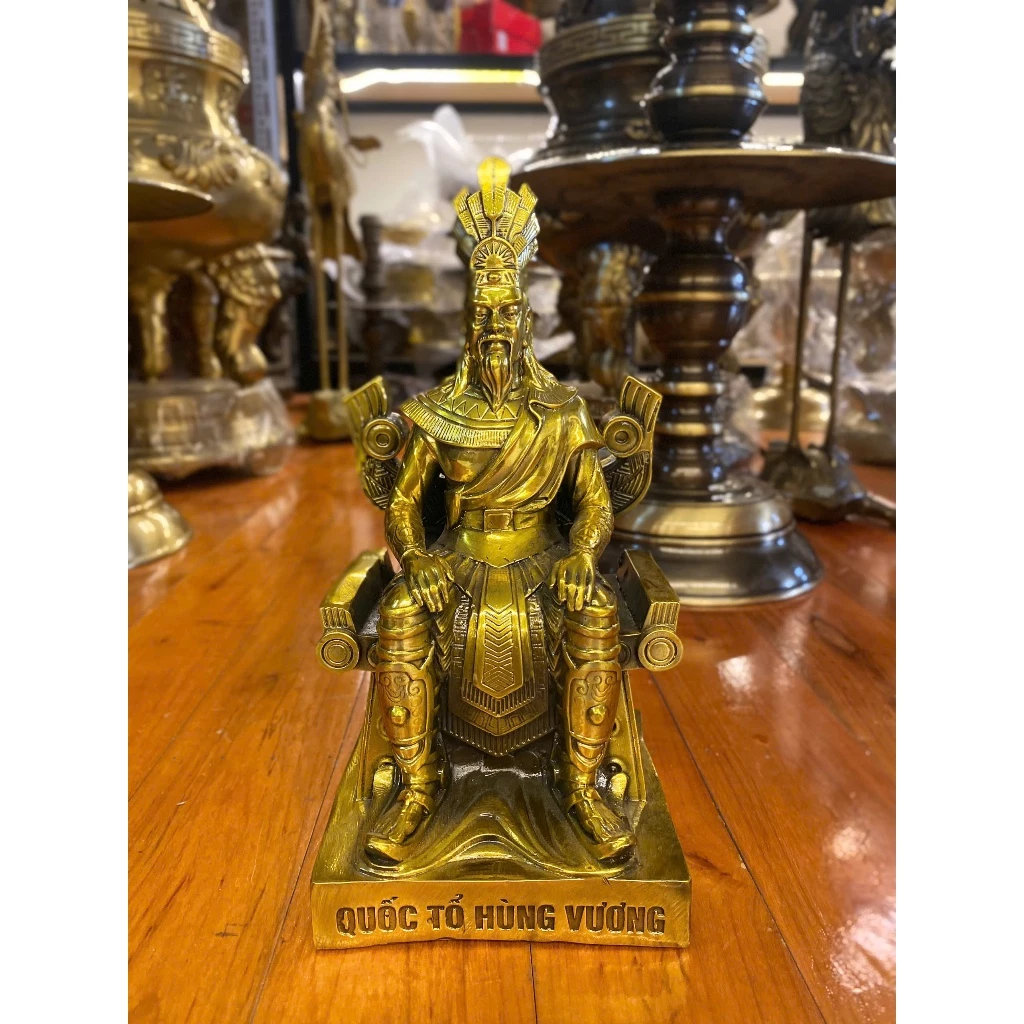
Hung King Bronze Statue with Antique Patina – Vietnamese Heritage
Hung King Bronze Statue with Antique Patina – Vietnamese Heritage
Couldn't load pickup availability
1. MEET YOUR HUNG KING STATUE – A HAND-CAST TRIBUTE TO VIETNAM’S ANCESTRAL HERITAGE
Connect with Vietnam’s ancestral traditions through this 25 cm Hung King bronze statue. Hand-cast in Vietnam and finished with a dark antique patina, the sculpture makes a meaningful addition to a heritage display or personal collection.
Product Details
- Subject: Hung King – Vua Hung / Hung Vuong
- Material: Yellow bronze
- Craftsmanship: Hand-cast
- Finish: Dark, blackened antique patina
- Height: 25 cm
- Origin: Vietnam
Who It’s For
A thoughtful choice for Vietnamese heritage collectors, families with a connection to ancestral traditions, or anyone seeking a culturally meaningful gift.
Display
Place the statue on a stable shelf, pedestal, or display surface in a respectful setting.
Handmade & Patina Notice
Subtle variations in casting details and surface tone may occur between hand-cast pieces. The dark antique patina is a decorative finish; it does not mean the statue is an antique.
Care
Dust gently with a soft, dry cloth. Avoid metal polish, abrasive cleaners, and harsh chemicals that could alter the patina. Keep away from prolonged moisture.
Shipping & Import Charges
Import duties and import taxes covered by Vietcraft.art.
We ship from Vietnam and cover import duties and import taxes for all shipping options listed below, including express shipping and heavy or bulky items. Shipping fees are separate from the product price.
For small, lightweight items, our preferred shipping services are USPS for deliveries to the United States, and Royal Mail or YunExpress for deliveries to the European Union. Heavy or bulky items shipped to the United States or European Union must use express shipping services such as UPS, FedEx or DHL. Items exceeding ePackage size limits must also use express shipping.
Standard Shipping to the United States
- Carrier: USPS
- Estimated delivery: 14–28 days
- Import duties and import taxes: Covered by Vietcraft.art
Standard Shipping to the European Union
- Carrier: Royal Mail or YunExpress
- Estimated delivery: 16–30 days
- Import duties and import taxes: Covered by Vietcraft.art
Express Shipping to the United States & European Union
- Carrier: UPS, FedEx or DHL
- Estimated delivery: 10–18 days
- Import duties and import taxes: Covered by Vietcraft.art
Please Note
Available shipping methods depend on your destination and the packed parcel’s weight and dimensions. Standard shipping is not available for heavy, bulky or oversized items. Delivery times are estimates, not guaranteed arrival dates, and may vary due to customs processing and local delivery conditions.
2. THE STORY BEHIND YOUR HUNG KING STATUE – ANCESTRAL REMEMBRANCE AND VIETNAMESE IDENTITY
The Hung King Worship Belief – Symbol of Great National Unity and Strength of the Vietnamese People
For a long time, in the Vietnamese consciousness, the Hung Kings are regarded as the founding ancestors who established the nation of Vietnam. The Vietnamese terms Vua Hung and Hung Vuong refer to the Hung Kings.
The Hung King worship belief holds an important place in spiritual life, carrying profound emotional value related to patriotism, pride, and national identity.
A Spiritual Connection Between Past and Present
Phu Tho Province is known as the residence of the ancient Vietnamese ancestors, located in the midland mountainous region of northern Vietnam.
It is also the cradle of wet-rice civilization and Vietnamese culture. Due to its geo-cultural position, Phu Tho has always been considered a sacred land where the Hung Kings founded the Van Lang State—the first Vietnamese nation—with its capital in Phong Chau.
The formation and development of the Land of the Ancestors influenced the development of the Hung King worship belief, rooted in the Vietnamese tradition of ancestor worship, which reflects the principle “When drinking water, remember its source”—filial respect for grandparents, parents, ancestors, and ethnic lineage.
The Hung King worship belief is an expression of the people’s faith in the presence of the Hung Kings. It is a fundamental and widespread belief fulfilling the spiritual needs of Vietnamese people domestically and abroad.
In contemporary life, this spiritual source still holds strong, embodied in the folk saying: “People live by their ancestors’ graves, not by a bowl of rice.”
This idiom emphasizes the importance of ancestral blessings and merits.
The formation and development of Hung King worship has evolved gradually and been enriched over generations. The Hung Kings are revered as the common ancestors of the Vietnamese nation.
Therefore, Hung King worship has become a distinctive cultural-religious belief in the spiritual life of Vietnamese people, serving as a spiritual foundation that creates the strength of the Vietnamese nation.
It symbolizes the source and power of great national unity and is a source of pride for the Vietnamese people throughout their history.
Scholars generally agree that Hung King worship has enduring vitality and widespread influence among Vietnamese communities both at home and abroad.
From the people’s perspective, pilgrimage to the Hung Temple, a place of ancestral commemoration in Phu Tho, is the desire and aspiration of many generations of Vietnamese. It is regarded as a journey back to the historical roots.
According to the legend of the “hundred eggs,” all Vietnamese people consider themselves siblings sharing a common origin, bloodline of Lac and Hong, and a common National Ancestor—the Hung Kings. “Lac-Hong” is a traditional expression referring to shared Vietnamese ancestry.
Individual and Community Aspects
On the individual level, pride in one’s ethnic origin is formed within the family, strengthened in the village, and developed nationally through blood relations: the Lac-Hong bloodline, descendants of Lac-Hong.
On the community and social level, Hung King worship is understood as collective memory and national heritage, fostering strong community bonds.
In other words, Hung King worship connects past, present, and future.
Distinctive Value of Hung King Worship: Traditional Moral Education
Alongside other religious beliefs, Hung King worship shows diverse forms of expression. Besides worshipping the Hung Kings, the temple also honors figures such as Princess Tien Dung, Princess Ngoc Hoa, and Tan Vien Son Thanh, a mountain deity in Vietnamese tradition.
Educating awareness of ancestors and national pride lays the foundation for kindness, community ethics, and reminds individuals to act according to social norms.
It strengthens faith in the protection and blessings of ancestral spirits and national heroes, thereby fostering patriotism and gratitude for the founders of the nation.
Socially, it is also a spiritual bond that unites the community and symbolizes national unity.
A Sacred National Festival of Vietnam
Throughout history, ancestor worship, prominently Hung King worship, has evolved to adapt to each historical cultural phase.
It has been supplemented and enriched by other religious and ideological systems, becoming a national belief with positive contributions and recognized as an Intangible Cultural Heritage of Humanity.
The Hung Temple Festival is considered a uniquely important festival for the Vietnamese nation:
“Whoever goes upstream or downstream,
Remember the Hung Kings’ death anniversary on the 10th day of the third lunar month.”
Research shows that Hung King worship originated as natural spirit and mountain deity worship.
According to legend, the Upper Temple on Nghia Linh mountain, a sacred site in Phu Tho, is where the Hung Kings held ceremonies to honor heaven and earth, rice deities, and prayed for favorable weather and people’s prosperity.
Until the late 19th century and before the temple’s restoration in 1917, worship here was a mix of mountain, rice spirit, and Hung Kings’ veneration.
Historically, from the Later Le dynasty, there was no national ceremony for the Hung Kings, and worship was performed locally.
From the Hong Duc era under King Le Thanh Tong, a ruler of the Later Le dynasty, the Hung Temple Festival became a national event, officially recognized by the royal court with appointed officials leading the rituals.
During the Nguyen dynasty, Emperor Minh Mang brought the Hung Kings’ tablets to Hue, the imperial capital in central Vietnam, to worship at the Imperial Ancestral Temple while still granting local worship rights in Phu Tho.
In the second year of Emperor Khai Dinh’s reign (1917), March 10th (lunar calendar) was established as the official festival day with formal ceremonies. Khai Dinh was a ruler of the Nguyen dynasty.
After the August Revolution in 1945, the young Vietnamese government paid great attention to the Hung Temple.
On February 18, 1946, President Ho Chi Minh issued Decree No. 22/SL-CTN allowing officials to have a day off annually on March 10th (lunar calendar) to organize Hung King commemoration activities.
During his lifetime, President Ho Chi Minh visited the Hung Temple twice, on September 19, 1954, and August 19, 1962.
On September 19, 1954, he gave a famous instruction to the cadres and soldiers of the Vanguard Army Division before entering the capital:
“The Hung Kings established the country, we – the Uncle and nephews – must together protect the nation.”
Share